Investigating the World War II Pigeon Cipher

One of the most fascinating mysteries from World War II involves a pigeon that was discovered in a chimney decades after the war ended, still carrying a small capsule with an encrypted message attached to its leg. The story was reported by the BBC and describes how the bird was found with a coded note believed to have been sent from a British military person during the war (https://www.bbc.com/news/uk-20456782).

After reading the article, I became curious about the origins of the message. Who sent it? Where did it come from? And perhaps most intriguingly, what did the encrypted message actually say? This paper explores the historical background of the pigeon message and attempts to identify the likely sender and context in which it was written.
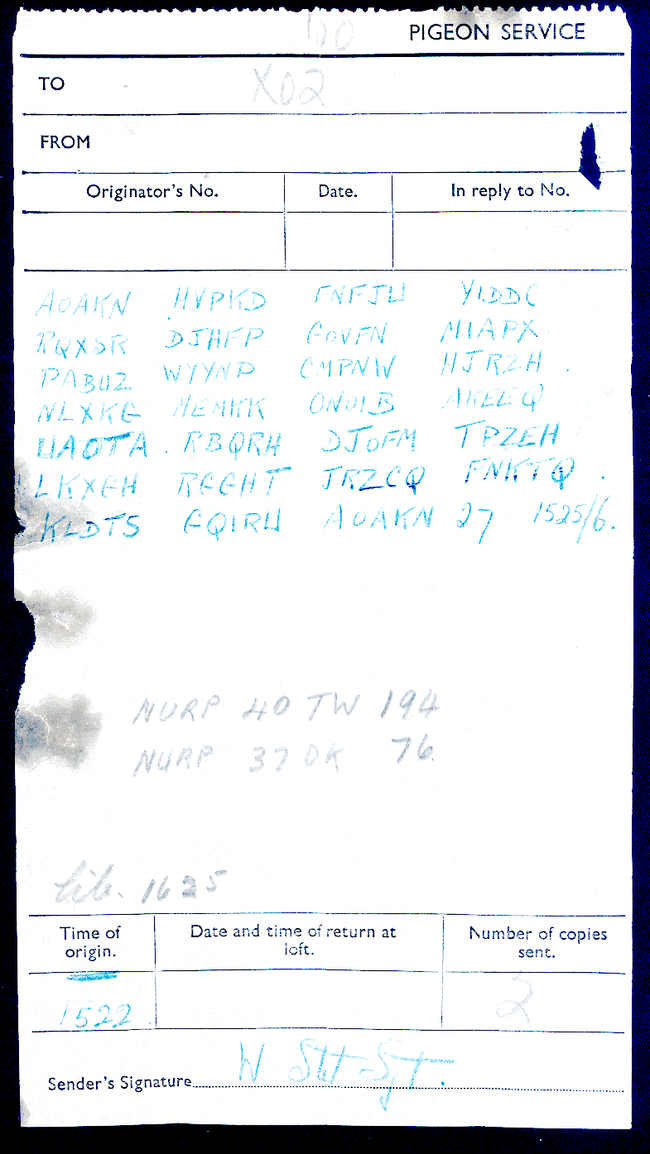
large-pigeon-message

The paper attached to the pigeon was a small, thin piece of tissue-like paper that had been tightly rolled and placed inside a red capsule tied to the bird’s leg. Written on the paper was a short message composed mostly of groups of five letters, which appeared to be encrypted text. Above the coded groups were several identifiers, including references such as “AOAKN,” “NURP 40 TW 194,” and “Pigeon Service.” The structured format of the message suggests it was created using a military communication system, likely intended to be decoded by personnel at a British base who possessed the correct cipher key. Because the decoding materials were never recovered, the message has remained unsolved.

World War 1 or 2?

One clue that helps identify the time period of the message is the format of the communication pad used for the note. The message is written in groups of five letters along with several short identifier codes at the top. This format was commonly used in British military communications during World War II. Messages were often written in groups of five letters so they could be transmitted more easily and so that patterns in the text would be harder for enemies to analyze.

Another important clue is the marking “NURP” written on the paper. NURP stands for the National Union of Racing Pigeons, an organization that worked with the British military pigeon service during World War II. These pigeons were used by aircraft and other military units to send messages back to base if radio communication failed.

The structure of the message and the organizations referenced on the paper strongly suggest that the message was created during World War II rather than World War I. British aircraft operating over the Atlantic often carried pigeons as a backup communication method in case the aircraft was damaged or forced to ditch in the ocean.

Some researchers initially suggested that the message might date back to World War I. One Canadian researcher proposed that the coded groups of letters resembled artillery fire control messages used during the First World War. In this interpretation, the message might have contained targeting information for artillery units rather than an aircraft communication. This theory was discussed online by historians and puzzle enthusiasts who examined the structure of the coded groups and compared them with known military message formats.

One example of this interpretation can be found in discussions archived on the BBC puzzle pages, where a contributor suggested that the message format resembled older artillery spotting messages from the First World War. https://www.wired.com/story/pigeon-code-cracked/

WW1 American Army Field Codes: https://archive.org/details/american-army-field-codes-in-the-american-expeditionary-forces-during-the-first-world-war

However, most historians later rejected the World War I theory. The references to the National Union of Racing Pigeons and the style of the message form more closely match British military pigeon communication systems used during World War II. Because of these details, the majority of researchers now believe the message likely originated during the Second World War.

Who’s the Author?
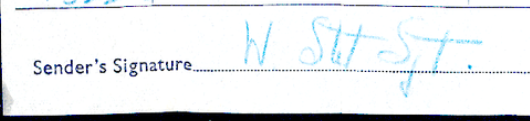
At the bottom of the message form there is a line labeled “Sender’s Signature.” Written in blue ink on that line appears to be the name “W. Stott Sgt.” The handwriting suggests the sender identified himself with the initial W, the surname Stott, and the rank Sergeant.

The name and rank are important clues. During World War II it was common for the sender of a pigeon message to sign the form so that the receiving station could identify the unit or individual who transmitted it. The rank Sergeant indicates the sender was a non commissioned officer rather than a commissioned officer such as a lieutenant or captain.

I searched www.cwgc.org and made a list of “W” “Stotts”. There are no matches for strictly “Stot”. The full list is the excel sheet I created. The best candidate with Sergeant is the one who served in the Royal Air Force and one promoted to Warrant Officer after his death in 1943.

Name Rank Service Number Unit Country Date of Death Age Burial / Memorial
William Leslie Stott Sergeant 508080 Royal Air Force United Kingdom 08 May 1945 35 Chester (Overleigh) Cemetery
William Stott Warrant Officer 407563 Royal Australian Air Force Australia 04 October 1943 33 Runnymede Memorial

Two individuals named William Stott stand out as possible candidates connected to the pigeon message. Both served in air forces during World War II and both held ranks that could match the signature written on the message form.

The first is William Leslie Stott, who served as a Sergeant in the Royal Air Force. His service number was 508080, and records show that he died on 8 May 1945 at the age of 35. He is buried at Chester (Overleigh) Cemetery in the United Kingdom. Because the message signature appears to include the rank “Sgt,” William Leslie Stott is a possible match based on rank alone. As a member of the RAF, he may have been involved in communication duties or air operations where carrier pigeons were used.

The second individual is William Stott of the Royal Australian Air Force, service number 407563. He served as a Wireless Operator Air Gunner and held the rank of Warrant Officer at the time of his death on 4 October 1943 at the age of 33. His name appears on the Runnymede Memorial, which commemorates airmen who were lost with no known grave. Historical records show that he was part of the crew of Liberator FK923 of No. 120 Squadron RAF, which disappeared during an attack on a German submarine in the North Atlantic.

This second individual is particularly interesting because wireless operators were responsible for sending and receiving communications. If an aircraft became damaged or unable to transmit by radio, the wireless operator would likely have been the crew member responsible for preparing a message and releasing a carrier pigeon. For this reason, William Stott of the Royal Australian Air Force is often considered one of the strongest candidates for the author of the pigeon message.

Although both individuals match the name and wartime context, the connection between the aircraft loss in October 1943 and the role of a wireless operator makes the RAAF William Stott a particularly compelling possibility.

Hand Writing Analysis

One piece of evidence that may help narrow the search is handwriting. By reviewing handwriting samples from enlistment documents of the various Stotts who served during the war, we can compare their signatures to the one on the message and determine which individuals might be possible candidates.

It took some time to track down and sort through the available digital military records. We should be grateful that the British and Australian governments have made so much of this historical information available to the public. Research like this would have been much more difficult to carry out years ago.
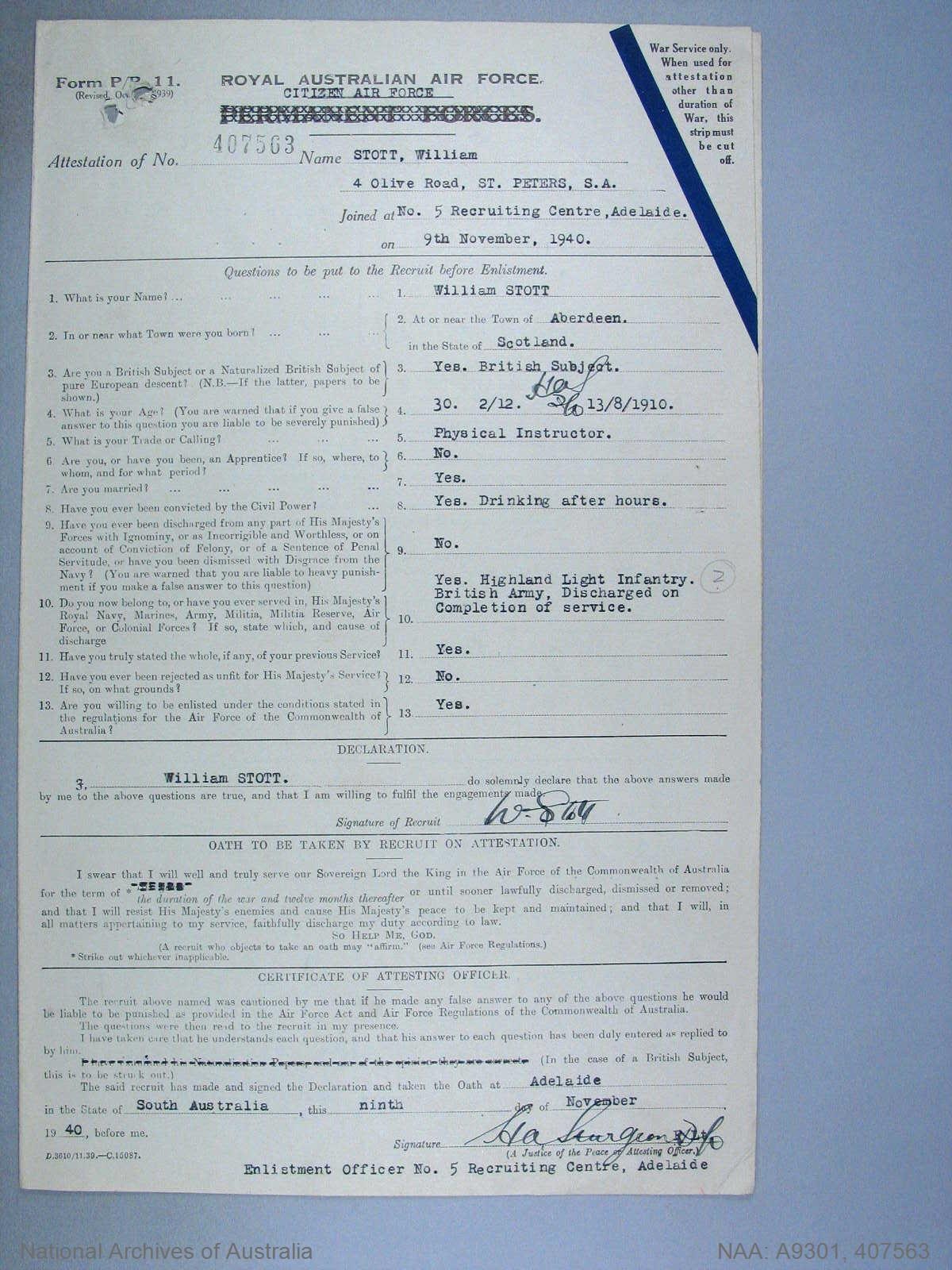
Australia W Stott Signatures
62685_1f53e61d_0294-00092

We have the original message handwriting and several options

Original Message Siganture
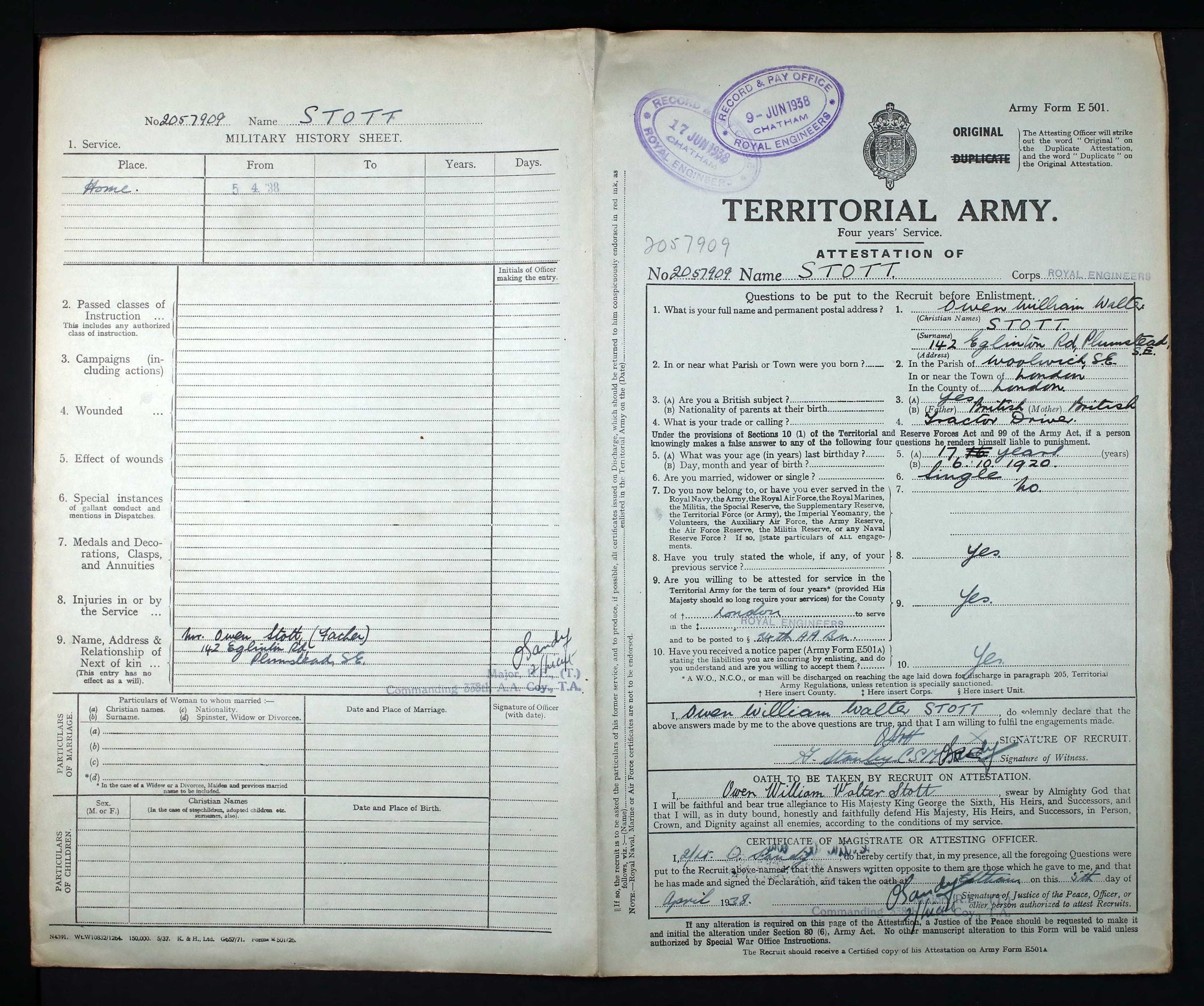
London W O Scott Signature
Australia W Stott Signatures - Cropped

We now have the original handwriting from the message along with several possible individuals to compare it to. For this comparison, I used the original signature from the message, a neutral reference sample from W. O. Stott of London, and our strongest suspect, W. Stott of the Royal Australian Air Force from Adelaide.

A comparison of the handwriting suggests that the Australian W. Stott signature is the closest match to the handwriting on the original message. The message signature begins with a tall, angular capital “W” followed by a shortened or simplified form of the surname that appears as “Stt.” The style is quick, somewhat block-like, and the letters are not fully connected. When compared to the enlistment documents, the Australian W. Stott signature shows several similar characteristics. The capital “W” is formed with similar sharp upward and downward strokes, and the overall structure of the name is compact, suggesting a writer who might abbreviate or simplify letters when writing quickly. This could explain why “Stott” appears shortened in the message. In contrast, the signature attributed to Owen William Walter Stott from London is written in a much more flowing cursive style. The letters are fully connected, the loops are more rounded, and the surname “Stott” is clearly written out with distinct letter forms. Because the London signature shows a more decorative and continuous writing style that differs significantly from the simpler and more abbreviated form seen on the message, it appears less consistent with the handwriting on the original note. While this visual comparison cannot serve as a formal forensic identification, the structural similarities in letter formation and writing style make the Australian W. Stott the more plausible handwriting match to the message signature.

With handwriting analysis, we observe the following:

Capital “W” Formation

Message signature

  • Tall capital W
  • Formed with three sharp angular strokes
  • Slight rightward lean
  • Ends with a small upward exit stroke

Australian W. Stott

  • Very similar angular W
  • Also constructed with distinct pointed peaks
  • Same rightward slant
  • Final stroke lifts slightly upward

Interpretation

The structure and stroke sequence of the W are highly consistent. Many writers produce rounded or looped W’s, but both samples show angular mountain-style W formation, which is a useful comparison feature.

Simplification of “Stott”

Message

Appears as:

Stt

or a compressed form of Stott.

Characteristics:

  • Very short middle section
  • The “o” loops appear omitted
  • Final t stroke is emphasized

Australian signature

  • “Stott” is written more formally
  • However the middle letters are compressed
  • The t strokes dominate the word visually

Interpretation

When people write quickly or under stress, interior vowels are often minimized or skipped. The Australian signature already shows compressed middle letters, which could easily reduce to “Stt” in fast writing.

Letter Spacing

Message

  • Letters are slightly separated
  • Not fully cursive
  • Appears written quickly

Australian

  • Semi-cursive
  • Letters almost connect but not fully
  • Slight pauses between name components

Interpretation

Both samples show partial connection rather than full cursive flow, suggesting a writer who mixes print and cursive habits.

Stroke Pressure and Rhythm

Message

  • Heavier strokes on W and t
  • Lighter strokes between letters
  • Indicates fast writing with emphasis on capitals and final letters

Australian

  • Similar emphasis pattern
  • Capital and cross strokes heavier
  • Interior letters lighter

Interpretation

This pressure rhythm is consistent between the samples.

Terminal “t” Style

Both signatures show:

  • A firm final t
  • Slight upward finish
  • A confident stopping point

This is another behavioral writing trait that tends to remain consistent.

The handwriting in the message shares several similarities with the Australian W. Stott signature, including the angular capital “W,” compressed surname structure, and similar stroke patterns. While these features suggest the two samples could come from the same writer, this comparison is only a preliminary visual assessment. It is recommended that professional forensic handwriting analysts examine the original documents and conduct a full comparison to determine whether the signatures can be reliably attributed to the same individual.

How did the bird make it back?
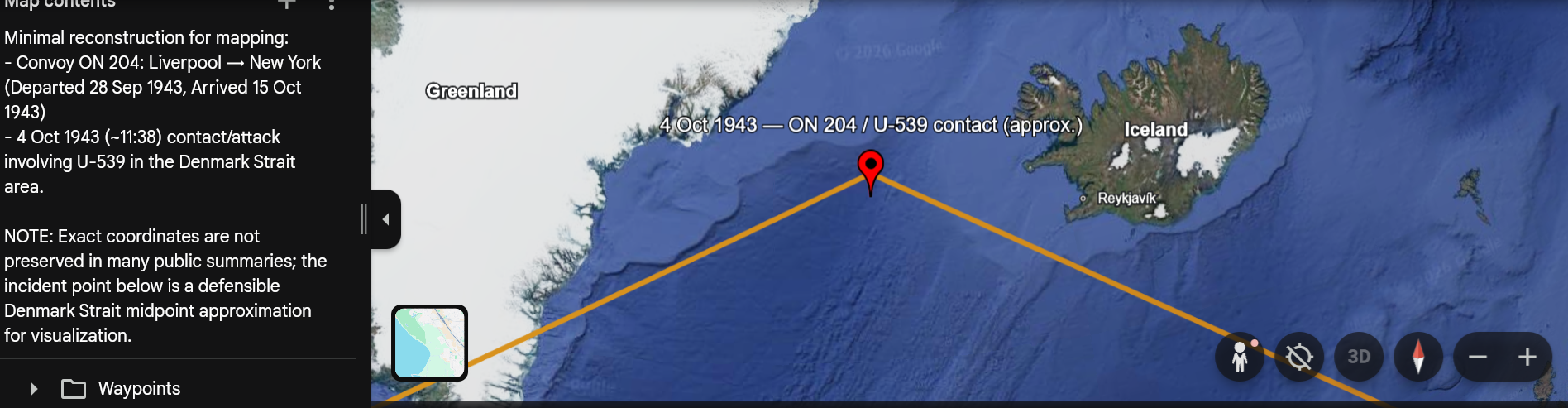
Death Location

The reconstructed position of the aircraft also aligns with what we know from personnel records and squadron history. Records show that Warrant Officer William Stott of the Royal Australian Air Force had been transferred to No. 120 Squadron RAF, which was operating Liberator aircraft from RAF Reykjavik, Iceland as part of the North Atlantic anti submarine patrol effort. On 4 October 1943, Liberator FK923 departed Iceland to escort Convoy ON 204. Squadron reports state that at approximately 11:30 a.m. a signal was received from the aircraft indicating it was about to carry out an attack, believed to be against U boat U 539. The signal faded and nothing further was heard from the aircraft, which never returned to base. Subsequent searches found no trace of the aircraft or crew. This means that on that specific day in October 1943 the entire crew, including RAAF Warrant Officer William Stott, was lost during the patrol, placing him directly aboard the aircraft at the time the message and pigeon were likely released.

Why the One Time Pad Message Cannot Be Cracked

The coded message carried by the pigeon appears to use a One Time Pad (OTP) system, which was widely used by Allied forces during World War II for highly sensitive communications. A one time pad works by combining a message with a page of completely random numbers or letters called a pad. Each character in the message is altered using the corresponding character from the pad. The crucial rule is that the pad page is used only once and then destroyed. The receiver has an identical copy of the pad page, allowing them to reverse the process and recover the original message.

What makes this system unique is that, when used correctly, it is mathematically unbreakable. Unlike other codes, there is no pattern for a computer or codebreaker to analyze. Every possible decoded message is just as likely as any other unless the correct pad page is known. In simple terms, it is like trying to guess a password that is completely random and just as long as the message itself. Even if someone used the fastest computers in the world, they would still be guessing blindly because there is no statistical clue pointing to the correct answer.

For this reason, the pigeon message cannot realistically be decoded today. The aircraft that carried the pigeon would also have carried the matching pad page used to encode the message. When the aircraft was lost in October 1943, that page of the pad was almost certainly lost with it. Without that specific page, the encoded text cannot be reversed. This means the message remains effectively locked forever unless the original pad page is somehow discovered, which is extremely unlikely.

This explains why, despite decades of effort by historians and cryptography enthusiasts, the pigeon message has never been successfully decoded. The security of the one time pad system means that the message is not merely unsolved; it is designed to be impossible to break without the original key.

Final Thoughts

In conclusion, the investigation narrowed the possible author of the pigeon message by systematically identifying and evaluating potential candidates named Stott who served during the war. Early on, it became clear that the message was not from World War I, as the use of coded pigeon message pads corresponds with British military pigeon communications used during World War II. With that timeframe established, attention focused on individuals who both served during the period and were in positions where sending such a message would make sense. Among the candidates examined, William Stott of the Royal Australian Air Force emerged as the strongest match. Records show that he served as a Wireless Operator Air Gunner with No. 120 Squadron operating from Iceland, placing him directly in aircraft responsible for anti submarine patrols and convoy protection. Squadron logs confirm that on 4 October 1943 his Liberator aircraft attacked U boat U 539 while escorting Convoy ON 204, after which the signal faded and the aircraft never returned. This scenario provides a credible moment in which an emergency pigeon message could have been released. Finally, a comparison of the handwriting on the message with known enlistment signatures showed notable similarities in the structure of the capital letters and the abbreviated style of the surname. While a definitive determination would require professional forensic examination, the combination of historical context, operational role, documented loss of the aircraft, and preliminary handwriting comparison makes William Stott the most plausible candidate identified in this investigation.
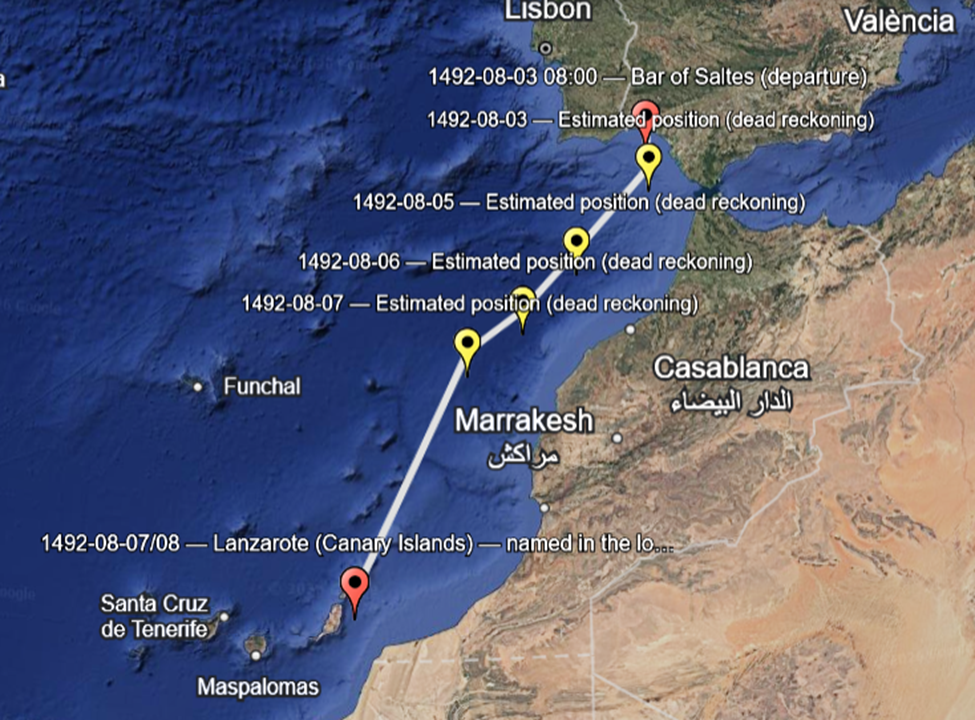

A Day by Day Reconstruction of Columbus’s 1492 Atlantic Crossing and more

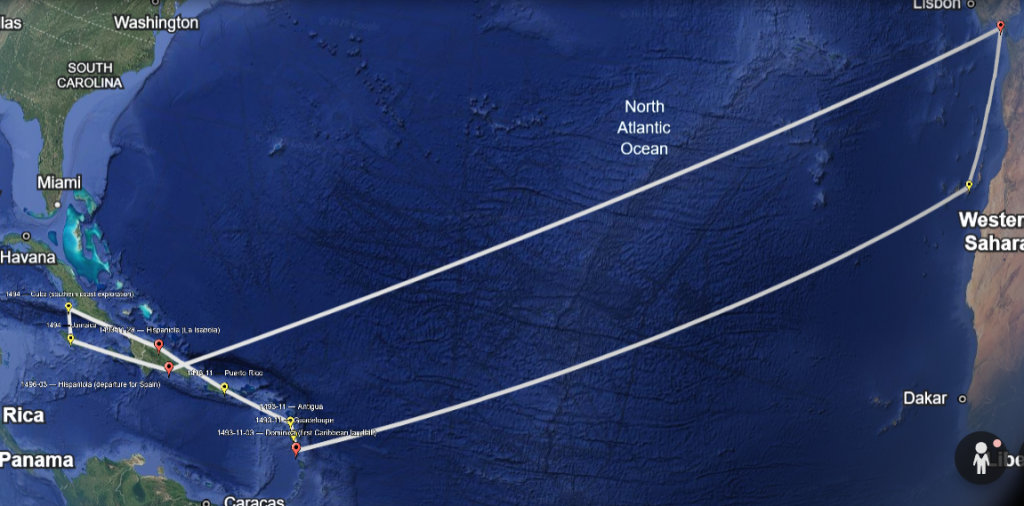
I have always been drawn to history, especially the way our understanding of the past often rests on a surprisingly small number of surviving written sources. In the case of Christopher Columbus, the original ship logs from the first voyage no longer exist. What we have instead are copies, summaries, and transcriptions preserved in the journals and correspondence of others, including versions recorded and translated decades later. These surviving texts, while imperfect, provide a rare day by day narrative of the voyage itself, including distances sailed, compass headings, weather conditions, and Columbus’s own private estimates alongside the figures he reported to his crew. Using the Diario de a bordo and related contemporary compilations and translations, including multiple Spanish and English editions of the first voyage journal and selected letters, it becomes possible to reconstruct the crossing through dead reckoning rather than illustration alone. By combining reported leagues traveled, noted course changes, and observations of magnetic compass behavior recorded in these primary sources, a plausible daily track can be estimated. This project begins that reconstruction by translating the written record into a KML map, allowing the voyage from departure to landfall to be examined one day at a time through the evidence Columbus himself left behind.

First Voyage

This KML represents a careful reconstruction rather than a claim of exact precision. It shows daily dots marking where Columbus would plausibly have been based on the leagues per day recorded in the log and the west, west southwest, and west northwest course changes he explicitly describes. It includes fixed anchors at La Gomera as the known departure point and Guanahani as the known landfall, connected by a continuous track line so the viewer can visually inspect drift, curvature, and pacing across the voyage. The file documents its assumptions clearly, including the use of one league as approximately three nautical miles, bearings treated as approximate true bearings derived from magnetic courses, and the absence of usable longitude fixes in 1492, which means uncertainty naturally increases in the mid Atlantic. Periods of calm and course changes guided by birds are preserved rather than smoothed away. When viewed, the track bends gently instead of forming a straight line, the days from October sixth through October tenth show noticeable course instability that aligns with crew anxiety and bird sightings, the final approach aligns logically with the Bahamas rather than Cuba or Florida, and the daily pacing feels human, with fast days, slow days, and pauses. Overall, this reconstruction is more historically honest than most published maps.

To actually see the reconstruction, we load the KML into Google Earth on the web. Open this in your browser:

https://earth.google.com

From there, go to Projects, choose Open or Import, and upload the KML file you downloaded from this chat. Once it loads, you will see the voyage as a connected track with dated dots. Clicking each dot opens the description text for that day, so you can follow the crossing step by step and visually inspect how the route curves, where it speeds up or slows down, and how the day by day pacing matches what the log describes.


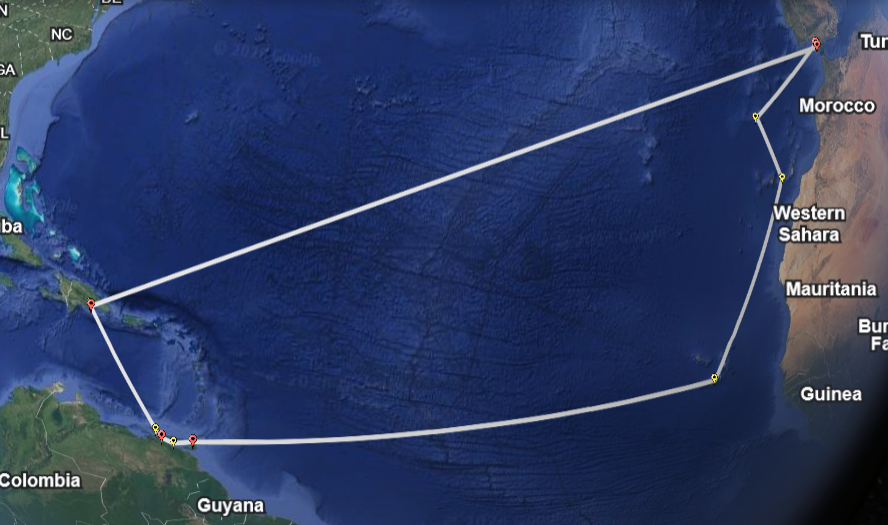
 Second Voyage

The second voyage of Christopher Columbus is documented far more broadly than the first, but the records are also more fragmented. Unlike the 1492 crossing, there is no single continuous ship’s diary that survives intact. Instead, the movement of the fleet must be reconstructed from a combination of letters, journal excerpts, official reports, and contemporary accounts written by Columbus himself and by those who sailed with him. These sources do not always agree in detail, but they consistently name places, dates, and sequences of movement that allow the overall path of the voyage to be traced with confidence.

This reconstruction was created by identifying every dated or clearly implied location where Columbus is attested to have been present during the second voyage, beginning with the departure from Spain in 1493 and ending with the return in 1496. Each point plotted in the KML corresponds to a place explicitly named in the surviving sources, such as known departures, landfalls, island visits, and extended stays. Rather than inventing daily positions where no distances or headings are recorded, the map anchors itself to these historically supported locations and connects them in chronological order to show the flow of the voyage.

The result is an anchored track rather than a dead reckoning line. This approach avoids artificial precision and reflects how the second voyage actually functioned. By this point, Columbus was no longer searching blindly across open ocean but moving deliberately between known islands and colonial centers. Navigation relied heavily on visual landfall, short sea passages, and repeated routes, which makes named locations more reliable than inferred daily distances. Where the historical record is silent or vague, the map remains intentionally conservative.

This KML is therefore best understood as a geographic index of the second voyage rather than a continuous navigational trace. It shows where Columbus was, when he was there, and how the expedition expanded outward from the initial Atlantic crossing into sustained movement across the Caribbean. When viewed alongside the first voyage reconstruction, it highlights the shift from uncertainty and exploration to repetition, logistics, and occupation, using the surviving documentary record as its sole guide.

Sources used for KML generation of 2nd Voyage:

  • Select Letters of Christopher Columbus, which preserves Columbus’s surviving correspondence to the Spanish Crown and others, including letters written during and immediately after the second voyage that reference specific locations, dates, colonial activities, and movements between the Canary Islands, the Lesser Antilles, Puerto Rico, Hispaniola, Cuba, and Jamaica
  • Letters from Christopher Columbus to Ferdinand and Isabella (1493–1496), transmitted as official reports and later copied into archival collections, providing dated references to departures, landfalls, settlement efforts, and returns that anchor Columbus to identifiable places even when navigational details are absent
  • Columbus’s memorials and administrative reports often labeled Relación, which summarize discoveries, colonial conditions, and travel sequences during the second voyage and survive through later copies rather than original manuscripts
  • The letter of Diego Álvarez Chanca, an eyewitness account written by a participant in the second voyage that describes the Atlantic crossing, first Caribbean landfall at Dominica, early island exploration, and conditions on Hispaniola, serving as one of the most reliable independent confirmations of dates and locations
  • The narrative account of Michele da Cuneo, an Italian nobleman who sailed on the second voyage and later recorded his experiences, providing corroboration for island sequences and movements while requiring careful critical reading
  • Historia de las Indias by Bartolomé de las Casas, which preserves summaries and quotations from documents that no longer survive and records chronological movement during the second voyage based on sources available to Las Casas in the sixteenth century
  • Vida del Almirante by Fernando Colón, written using family papers and now lost records, offering sequencing and contextual detail for the second voyage, particularly regarding Hispaniola and the wider Caribbean
  • Historia General y Natural de las Indias by Gonzalo Fernández de Oviedo, which compiles early testimonies, official documents, and firsthand accounts that preserve locations, dates, and movements associated with the second voyage

This combined documentary record forms the basis for the anchored KML reconstruction, relying on named places and dated attestations rather than inferred daily navigation where the sources remain silent.


Third Voyage

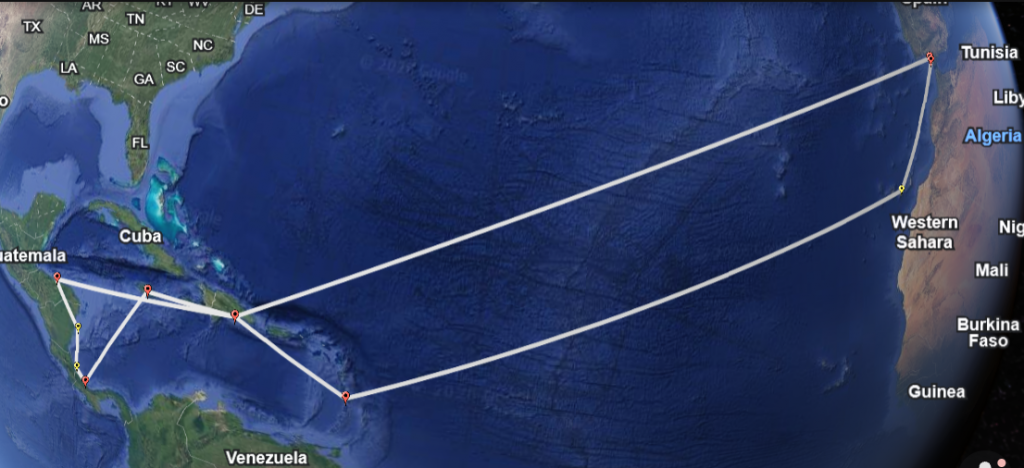
The third voyage of Christopher Columbus is reconstructed differently from the first two because the surviving record emphasizes events and locations rather than continuous navigation. No complete ship’s log survives for this voyage, and the sources that do exist consist primarily of letters, official reports, and later historical compilations that record where Columbus was at specific moments rather than how he traveled day by day. To build this KML, every dated or clearly implied location mentioned in these documents was identified, beginning with the departure from Spain in 1498 and ending with Columbus’s forced return in 1500. Each placemark represents a place where Columbus is explicitly documented to have been present, such as known staging points in the Atlantic, first landfall at Trinidad, exploration of the Gulf of Paria and the South American mainland, extended residence on Hispaniola, and his arrest at Santo Domingo. These anchored locations were then ordered chronologically and connected to show the overall movement of the voyage without imposing artificial precision where the sources are silent. This method reflects the historical reality of the third voyage, which was defined less by open ocean navigation and more by coastal exploration, settlement, and political collapse, and allows the map to remain faithful to what the documentary record can actually support.

Here is the single long bullet list of sources used for reconstructing Christopher Columbus’s Third Voyage (1498–1500), written consistently with the earlier voyages:

  • Select Letters of Christopher Columbus, which includes letters written by Columbus to the Spanish Crown during and after the third voyage, describing his route to the south, first landfall at Trinidad, exploration of the Gulf of Paria, his belief that he had reached a continental landmass, and the deteriorating political situation on Hispaniola
  • Letters from Christopher Columbus to Ferdinand and Isabella (1498–1500), preserved through later copies and archival compilations, which provide dated references to departures, landfalls, coastal exploration near South America, and Columbus’s reports of unrest and resistance to his authority
  • Columbus’s memorials and formal reports commonly referred to as Relación, which summarize discoveries, geographic observations, and administrative actions taken during the third voyage and survive through later transcription rather than original manuscripts
  • Historia de las Indias by Bartolomé de las Casas, which preserves summaries of now lost documents and provides a chronological account of the third voyage, including Columbus’s movements around Trinidad, the Paria coast, and Hispaniola
  • Vida del Almirante by Fernando Colón, written using family papers and records that no longer survive, offering sequencing and contextual detail for the third voyage and Columbus’s changing perception of the lands he encountered
  • Historia General y Natural de las Indias by Gonzalo Fernández de Oviedo, which compiles early testimonies, official correspondence, and firsthand accounts that record locations, dates, and events associated with the third voyage
  • Official Spanish administrative records relating to Francisco de Bobadilla, including orders, reports, and correspondence concerning the investigation of Columbus’s governance on Hispaniola, his arrest in 1500, and his transport back to Spain, which anchor the final phase of the voyage to specific places and dates

Together, these documents form a fragmented but overlapping record that allows the third voyage to be mapped through anchored, historically attested locations, avoiding conjectural daily navigation while remaining faithful to the surviving evidence.


Fourth and Last Voyage

The fourth and final voyage of Christopher Columbus survives in the historical record primarily through letters, reports, and later chronicles rather than through a continuous ship’s log. By this stage of his career, Columbus was no longer engaged in open ocean discovery but in deliberate coastal exploration, repeated landfalls, and prolonged periods of enforced immobility. To construct this KML, all surviving documentary references that place Columbus at a specific location during the years 1502 to 1504 were collected, including departure and return ports, named island landfalls, coastal regions along Central America, and the extended stranding in Jamaica. Each of these locations is supported by contemporary correspondence or early historical compilations that preserve the sequence of events even where navigational detail is absent.

The mapping approach used here is intentionally anchored rather than speculative. Instead of attempting to infer daily positions or routes where no distances or headings are recorded, the KML plots only those places where Columbus is documented to have been present and connects them in chronological order. This method reflects the character of the fourth voyage itself, which was shaped by storms, ship deterioration, political exclusion from Hispaniola, and long periods without movement. Coastal segments along Honduras, Nicaragua, Costa Rica, and the Veragua region are shown as sequential stops rather than continuous tracks, while the Jamaica phase is represented as a fixed location spanning many months. The resulting map presents the fourth voyage as it appears in the historical record, grounded in documentary evidence and free from artificial precision, allowing the geographic scope and narrative progression of Columbus’s final expedition to be examined with clarity and restraint.

Here is the single long bullet list of sources used for reconstructing Christopher Columbus’s Fourth Voyage (1502–1504), consistent with the earlier voyages and grounded in the surviving documentary record:

  • Select Letters of Christopher Columbus, which contains letters written by Columbus during and after the fourth voyage describing his final expedition, his exclusion from Santo Domingo, coastal exploration along Central America, the worsening condition of his ships, and his prolonged stranding in Jamaica
  • Letters from Christopher Columbus to Ferdinand and Isabella (1502–1504), preserved through later copies and archival compilations, which provide dated references to departure from Spain, encounters in the Caribbean, reports of storms and ship damage, appeals for assistance while stranded, and his eventual return
  • Columbus’s memorials and reports commonly referred to as Relación, which summarize discoveries, hardships, and decisions made during the fourth voyage and survive only through later transcription rather than original manuscripts
  • Historia de las Indias by Bartolomé de las Casas, which preserves narrative summaries and quotations from now lost documents and provides a chronological account of the fourth voyage, including the Central American coast and the Jamaica stranding
  • Vida del Almirante by Fernando Colón, written using family papers and records that no longer survive, offering sequencing and contextual detail for the final voyage and Columbus’s declining authority and health
  • Historia General y Natural de las Indias by Gonzalo Fernández de Oviedo, which compiles early testimonies, official correspondence, and firsthand accounts that record locations, dates, and events associated with the fourth voyage
  • Contemporary Spanish administrative correspondence and royal directives, including orders, responses, and reports related to Columbus’s authority, restrictions placed upon him during the voyage, and arrangements for his rescue and return, which anchor the final stages of the expedition to specific places and dates

Together, these sources form a fragmented but overlapping record that allows the fourth voyage to be mapped through anchored, historically attested locations, avoiding conjectural navigation while remaining faithful to what the documentary evidence can actually support.

Sheena Ringo – Video Film Location Found

For years going all the way back to the late 1990s Japanese music drifted into my life thanks to a friend named Chris. SPEED. The Brilliant Green. Hikaru Utada. Namie Amuro. Mad Capsule Markets. It wasn’t a phase so much as a slow steady exposure the kind that seeps in without asking permission.

Eventually I stumbled into Shiina Ringo and the early days of her work. One video in particular stuck with me Kōfukuron. Not because it was flashy or exotic but because it felt lived in. Real. A place you could actually stand.

Back then Japan was an idea something distant and hypothetical. I hadn’t been yet. So I did what people do when they want to belong to a place they’ve never seen I imagined it. I wondered where those stairs were. Who walked them. What the air smelled like that day.

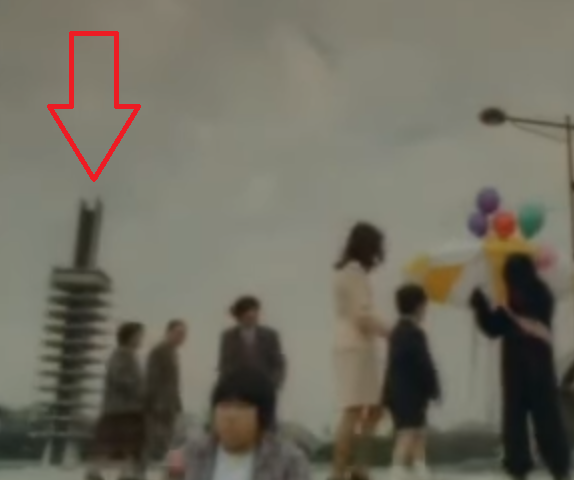
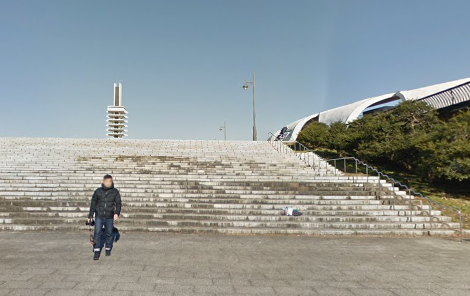
Last week curiosity finally got the better of me. I went digging Google Images map views old angles and shadows tracking down a building in the background until the geography snapped into place. Komazawa Park. Setagaya. Tokyo. Suddenly the mystery was gone. Or maybe it was just sharper.

image
Film location

And here’s the strange part no one else seems to have written this down. No tidy list of filming locations. No footnotes. Nothing. So this isn’t authority it’s observation. Careful comparison. The satisfaction that comes from finding a place not because it was labeled but because it made sense.

Coordinates don’t lie.

35.624452, 139.661967
Komazawa Park
Setagaya City, Tokyo, Japan
https://maps.app.goo.gl/XQumSCs8vGe2xH2S8

And now it’s no longer just a video location. It’s somewhere I can actually go. Stand. Look around. Let the moment catch up to me.


1990年代後半から長い間、友人のクリスのおかげで日本の音楽が私の生活に入り込んできました。SPEED。The Brilliant Green。宇多田ヒカル。安室奈美恵。Mad Capsule Markets。流行というよりも、気づかないうちに染み込んでいくような、静かで継続的な出会いでした。

やがて椎名林檎の初期の作品にたどり着きます。その中で特に心に残ったのが「幸福論」でした。派手だからでも、異国的だからでもありません。そこには生活の気配があり、現実感があり、実際に立てる場所として存在しているように感じられたのです。

当時の日本は、私にとっては遠く抽象的な概念でした。まだ一度も訪れたことがなかったからです。だからこそ、人は行ったことのない場所に惹かれるとき、想像します。あの階段はどこにあるのだろう。誰がそこを歩いたのだろう。あの日の空気はどんな匂いがしたのだろうか。

先週、その好奇心がついに勝ちました。Google画像や地図、古い視点や影をたどりながら、映像の背景に映る建物を手がかりに調べていきました。そして地理が一気につながった瞬間が訪れます。駒沢公園。世田谷。東京。謎は消えたというより、よりはっきりとした形を持ったように感じました。

不思議なのは、この場所について誰も書き残していないことです。撮影地の一覧もなければ、注釈もありません。何もない。だからこれは権威ではありません。観察です。丁寧な比較です。ラベルが付いていたからではなく、理にかなっていたから見つけ出せた場所にたどり着く、その満足感です。

座標は嘘をつきません。

35.624452, 139.661967
駒沢公園
東京都世田谷区

そして今、ここは単なる映像の中の場所ではなくなりました。実際に行ける場所です。立ち止まり、周囲を見渡し、時間が追いつくのを待つことができる場所なのです。

Travel to Japan

People keep asking me about Japan. Friends, acquaintances, people I barely know but who’ve seen the photos and want a taste of the same magic. So I made this site—not a glossy brochure, not a sanitized guidebook, but something to get you thinking about what you might want to see, eat, and experience.

My love of travel started young, but Japan… that hit me in high school. Back then, I thought it was the promised land—neon-lit technology utopia, vending machines that never broke, a place where trains ran on time and the future already existed. That’s the fantasy. And it’s true—up to a point.

But I’ve gone past that wide-eyed tourist phase. Japan isn’t a theme park. It’s real life, complicated, messy, beautiful. I’ve been lucky enough to catch glimpses of that too. For now, though, this post is for the traveler—the one just passing through. A temporary visitor looking to get lost in the backstreets, eat something unforgettable, maybe even feel for a moment that impossible combination of order and chaos that makes this place what it is.

I have Power Points for you

Yeah, my job hardwired me to live and die by PowerPoint. Sounds like a gimmick, but it’s not. Those slides have saved my ass more than once—like the time my phone died and I still had all the info I needed printed out.Make a plan. How you’re getting from the airport to your hotel, where you’re staying, what you’re doing, how you’re getting around, and how you’re getting back home. Don’t overcomplicate it, but don’t wing it either. Extra points if you put together a budget sheet. Nothing kills the buzz of travel faster than realizing you blew through half your money by day three.

Season to Travel

When it comes to Japan, the season you choose depends on three things: how much weather you can handle, how fat your wallet is, and how long you’ve got to burn. Oh, and don’t forget where you’re flying in from. Rule of thumb—keep the flights as direct as possible. Every extra hop is another chance for delays, bad airport food, and soul-crushing jet lag. But hey, if adding one layover saves you half the cost of your ticket, grit your teeth and deal with it.

Geography lesson: Japan stretches from the icy north of Hokkaido to the subtropical south of Okinawa. That’s a big spread, and the weather is as varied as the food. The chart below sticks to the main island—the Tokyo and Osaka corridor where most visitors end up. Pay attention, because what feels like spring in one part of the country might feel like a wet wool blanket in another.

Area of ConcernSpringSummerFallWinter
Flight Costs$800
to 2000s
$800s
to $1400s
$700 to $1000$500 to 1000
WeatherSomewhat cold a night and light jacket during day Hot, HumidSome days hot, most days comfortableFreezing sometimes, comfortable with warm clothes

Picking Flights

Out of LAX, ZipAir is my go-to into Tokyo. Cheap, no-frills, and it gets the job done. Tokyo’s got two airports, and when you land matters. Don’t be the genius who books the flight that touches down after 8 p.m.—unless you enjoy wrestling customs, sprinting through train stations, or shelling out for a sad airport hotel or a taxi that costs as much as your ticket.

Leaving LAX? Time of day doesn’t matter much. What does matter is parking. Book long-term in advance and you’ll save a pile. Shuttles usually run like clockwork. If you’re coming from San Diego, forget about driving yourself—there are budget shuttles from Old Town straight to LAX. Way better than blowing money on a pre-flight hotel. And whatever you do, don’t tempt fate with rush hour traffic. You will lose.

If your flight leaves before 10 a.m., do yourself a favor and go up the night before. Otherwise, set the alarm, plan for war, and be at the airport three hours early. Check-in is always a grind, never a joy.

For the experience, I’ll tip my hat to StarLux and Japan Airlines—both still know how to keep the booze flowing and the food edible. And one last piece of advice: don’t waste your money eating at LAX. Japan has konbini—convenience stores that put most restaurants to shame. Soon enough you’ll be living off rice balls, fried chicken, and canned coffee for pocket change. And you’ll love it.

Picking Lodging

Where you stay in Japan boils down to three things: budget, body count, and how soft a bed you need to sleep on. Rolling in with more than four people? Forget hotels—you’ll end up paying out the nose. AirBnB is your friend. For smaller groups, expect two per room if you want to stay sane.

Big-name hotels will happily charge you $200 a night and give you more space to sprawl, but honestly, most travelers don’t need it. Standard hotels usually run between $50 and $80 a night, depending on where you land. Tight rooms, sure—but you’re in Japan. You’re not supposed to spend the day in your hotel room watching TV.

I’ve got a few favorite spots I’ll share, but the real advice is this: don’t get hung up on luxury. The magic isn’t in the thread count—it’s in the ramen joint down the street, the midnight konbini run, the way Tokyo feels when you step outside at 2 a.m.

Tokyo

For first-timers, you’ve really got two choices: Shinjuku or somewhere near Tokyo Skytree. Flying into Narita? Skytree’s your easiest bet—close, direct, and no drama getting into the city. From there, the rest of Tokyo is yours. Coming and going through Haneda? Shinjuku is the move. It’s messy, electric, crowded in the best possible way. The Tokyo most people dream about.

If you’ve already been around the block in Japan, you’ll probably branch out to new neighborhoods—or keep going back to your old standbys. I mostly split time between Shinjuku and Skytree myself, with the occasional detour to Machida City. That last one? Skip it if this is your first rodeo.

Airbnb can be a solid play in either spot, especially if you’re rolling with a crew. But if it’s just you, or two, maybe four—splurge on the Hilton or Hyatt for a night. You’ll know the vibe the moment you step in: Lost in Translation, jet-lagged, staring out the window at neon Tokyo in the rain. Worth it.

On a tighter budget? Tokyo-Inn and APA have never let me down. Rooms are small, beds are smaller, but that’s Japan. You’re not there to hang out in a hotel room. The Hilton in Shinjuku is my go-to when I want space; APA when I just want a bed and a hot shower. I’ve even done Airbnb and walked away satisfied.

One last note: you’re going to live on trains and subways here. Pick your place based on access, not amenities. And when it comes time to book, I usually run it through Orbitz or Google. Simple, fast, and no games.

Osaka & Kyoto

If you’re coming into Osaka, plant yourself in the center of the city. That’s where the action is. I usually stay near Osaka Castle—my go-to is the Lutheran Hotel. Yeah, it’s got a church attached, but don’t let that scare you off. The price-to-comfort ratio is almost absurd for Japan: spacious rooms, clean, and easy on the wallet. Otherwise, you can always fall back on the APA chain. They’re everywhere, reliable, and exactly what you expect—just check the reviews to avoid the duds. Getting around Osaka means trains or ride shares, so plan for that. Three nights here is more than enough to soak in the food, the neon, and the chaos. Any more and you’ll just be circling back on yourself.

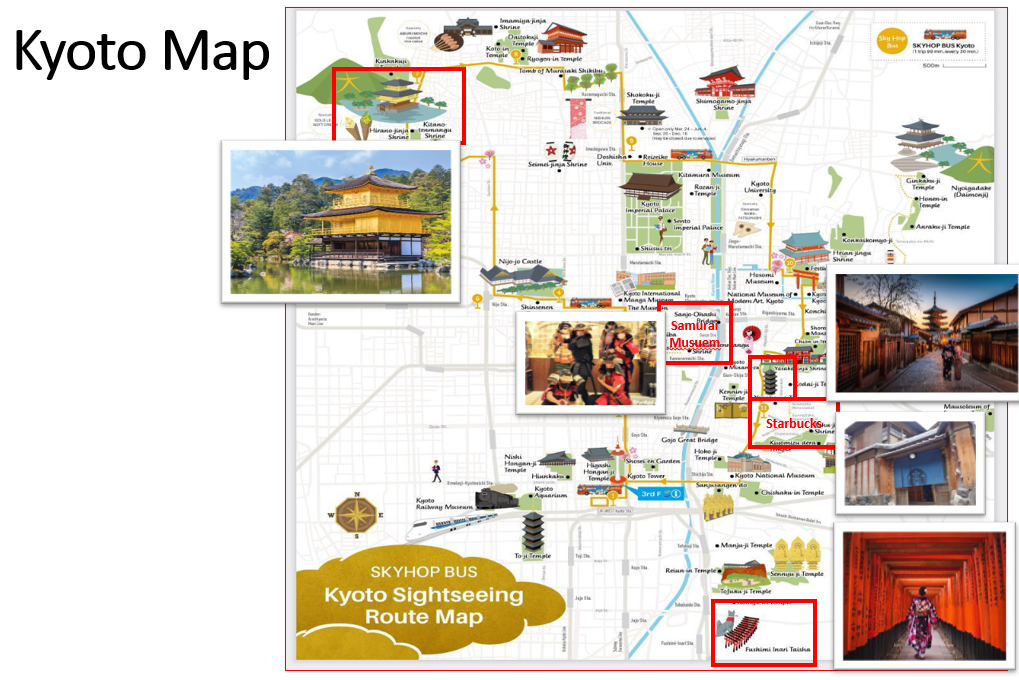
Kyoto’s a different story. This isn’t a city you “do” in a day, but you also don’t need a week. Two nights, tops. When you come in by train, drop your bags in the older eastern district. Pay the extra twenty bucks—it’s worth it to wake up and stroll straight into quiet streets and temples before the tour buses flood in. Stay close enough to walk to the old wooden Starbucks, the one built into a historic machiya. Yes, it’s a Starbucks, but the building is pure Kyoto, and you’ll thank yourself for the experience when you’re sipping coffee in creaking wooden beams instead of a sterile glass box.

How to pack for this country

Don’t drag a giant suitcase across Japan. Nothing says “lost tourist” like wheeling half your closet through Shinjuku Station. Pack for five days. That’s it. If it’s summer, two pairs of shorts, five shirts, five socks, five underwear, one bathing suit. Maybe a decent shirt if you plan to eat somewhere nicer than a ramen counter. Nobody’s expecting Americans to show up in a suit, but let’s be clear—wearing a white beater in public makes you look like you’ve just been evicted. Have a little self-respect.

Toiletries? Toothbrush, toothpaste, whatever basics you need to feel human when you land. Everything else—shampoo, conditioner, medicine, tampons—you’ll get cheaper, better, and probably weirder in Japan. Pack your cologne or perfume if that’s your thing. Deodorant too, especially if you need something specific. Otherwise, you’ll survive.

Tech is non-negotiable. Phone chargers, a battery pack—best bought stateside. Check international data with your carrier, or if you’re cheap (and smart), pick up a local eSIM. Pre-buy one before you go, but make sure your phone’s unlocked or you’ll be out of luck.

And if you forget something? Relax. This is Japan. You’ll find it. Convenience stores and pharmacies are everywhere. You’re not trekking through the Amazon—you’re in one of the most efficient, consumer-friendly countries on earth.

Suggested Packing List:

Packing ItemWhere to Buy
International Power Charger Block
(existing two-prong US chargers will work on certain sockets)
$8 : https://amzn.to/409WiZW
Portable Recharging Battery$26: https://amzn.to/49RmLyO
Cell Phone CablesBring existing cables. I would recommend a main and backup set.
Durable Travel Luggage$210: https://amzn.to/3VPUnHC
I’ll create a luggage post soon. I use this very case.
Travel Fold-able Duffel Bag
(For shopping overflow and where you want to store your treasures)
$15 or less : https://amzn.to/41Pf2z7
Travel Backpack
(Try low weight, small space types)
$19 or less: https://amzn.to/4fyODZL
Non-Expensive Sunglasses and HatExisting if you can. Can get dirty and trashed
5 days of underwear and socksExisting if you can
2 pants, 2 day shorts, 4 shirts,1 workout outfit, 1 beltExisting if you can
One pair of walking shoesExisting and expect to get dirty
Toiletry Items – Travel toothpaste, toothbrush, soap, and shampoosExisting or buy at home. Place in gallon zip lock bag
Prescribed Medicines and Melatonin (for sleep)All other medicine is available there and 1/20th the cost found in USA
Cell phones, electronic entertainmentExisting cell phone, Nintendo Switch, tablets
Travel Cell Phone Tripods$40 : https://amzn.to/3BHkjOI
I’m a fan of Manfotto for quality and resale
Wireless headphones$20 : https://amzn.to/3VTPuxa
Cheaper than airport costs
Extra Credit CardsYou’ll end up pulling cash out at the first ATM, but have extra credit cards for crazy emergencies.
International Travel for Cell PhoneCheck your provider. Getting eSIMs may work, but unsure about Egypt. I was charged $10 day for Egypt. Could hotspot if you need others to borrow traffic.
Printed copy of your travel plans power point. Includes copy of your passport.

Arriving at airport

If you’re flying out of San Diego, you can park long-term for about ten bucks a day—but honestly, why bother? Get dropped off, grab a rideshare home when you’re back. Cheaper, easier, no stress. If you’re dealing with LAX, book long-term parking a day or two ahead and ride the shuttle in. Don’t get suckered into the close-in lots unless you like throwing away a couple hundred bucks for convenience you don’t need.

Carry-on strategy: if you’re smart enough to pack light, check that bag on the way home. Outbound, doesn’t matter. Just keep your backpack stocked—book, phone, USB charger, maybe a block. If you’re flying ZipAir, remember: no seatback TVs, no endless stream of bad movies. You’re your own entertainment.

And then there’s security. It’s always a grind. Expect lines. Expect waiting. Give yourself two hours, minimum, just to get through the whole cattle drive. Me? I’m always early. Beats sweating it out at the checkpoint while your flight boards without you.

Travel to Lodging

This is where planning pays off. Before you even get on the plane, screw around with Google Maps. Figure out where you land, then tack on an hour and a half for customs, baggage claim, and the general circus of getting out of the airport. If your flight lands after 10 p.m., don’t be a hero. Book a hotel near the airport. Fighting train schedules at midnight is a losing game.

Buying train tickets online? Forget it. For first-timers, it’s a nightmare. Just step outside, soak in the sea of Japanese signage, and head straight for the ATM. Test your card. Pull out about $300 in cash. Japan runs on cash, and you’ll burn through it faster than you think. Just make sure you tell your bank you’re going to Japan before you leave, unless you enjoy begging through international call centers at baggage claim.

With cash in hand, you’ve got buses and trains. I’m a train guy. Use Apple or Google Maps—they’ll tell you when the next train’s rolling in. You’ll either fumble your way through the smart card system (good luck) or buy one of those little yellow tickets. Keep it in your wallet like gold. First train ride feels alien, intimidating. Rule number one: don’t be that tourist. Trains are quiet. No loud conversations, no acting like you own the place. And if you see an old woman standing—give her your seat. It’s basic humanity.

If you don’t know what you’re doing, find another American. Misery loves company, and you’ll figure it out together. Trust me—you’ll get the hang of it. I believe in you.

When you reach your station, the fun begins. You’ll need that yellow ticket to get out. Half the time the gate will spit it back at you like a bad joke. Look for the station guard, wave the ticket—he’ll usually let you slide through. If not, hit the fare adjustment machine, feed it some yen, and it’ll spit out a fresh ticket that works. Congratulations. You’ve survived the first boss battle.

And yes, eventually you’ll graduate to a smart card. Maybe even download the app. But Japan’s app scene isn’t slick like back home. In the end, cash is king here—and for a first-timer, that’s the safest bet.

How to daily travel

If you’ve mapped your trip right, trains are your best friend. They’ll take you just about anywhere you need to go. But here’s the reality: you’re going to walk. A lot. Ten, fifteen, hell—twenty-five thousand steps a day if you’re really chasing it. Your feet will hate you. Suck it up.

I live by what I call The Event Rule. Don’t overdo it. Burnout kills a trip faster than bad weather. With kids, one or two events a day is plenty. For adults, think in terms of two neighborhoods or two big stops. Maybe a museum in the morning, a major attraction in the afternoon. Fill in the gaps with food, drinks, random detours—that’s where the real magic is.

For short hops, rideshare is a lifesaver. I use “Go.” Download the app, toss in a card, and you’re set. No tip games, no nonsense. They pick you up, drop you off, and you’re only out twenty-five bucks or so if it’s a quick 10–15 minute ride. Anything longer and the price starts to bite. Perfect for when you’re tired, lost, and muttering fuck this under your breath.

Taxis still have their place. Reliable, clean, and usually cash-first. Always have yen in your pocket—it makes the whole exchange smoother. Swipe if you must, but cash keeps it simple, keeps it fast. In Japan, that’s always a win.

How to eat and drink

For the tourist, Japan is exactly what you think it is. Everything you’ve seen on TV? It’s here, waiting. Sushi that’ll ruin you for life, ramen that’ll make you sweat and smile, yakitori smoke rising from street stalls at midnight. If you’re in it for the full experience, you can eat sushi and noodles until you physically can’t anymore. Yelp and Google? Use them. They don’t steer you wrong often. Just remember—smaller joints are usually cash only. Another reason I tell you to keep yen in your pocket.

Of course, if you’ve got picky eaters in tow, like my stepdaughter on her first trip, don’t worry—there’s always a glowing KFC or McDonald’s around the corner. No shame. They’re oddly better here than back home. My own guilty pleasure? Denny’s. Yeah, Denny’s. Ten bucks or less gets you a full American-style breakfast—salmon, rice, miso, eggs, coffee. I’ve written about it before, and I’ll write about it again.

But the real goldmine? Convenience stores. 7-Eleven, Lawson, Family Mart. Forget everything you know about them in the States. This is another universe. Egg salad sandwiches so soft they practically dissolve, hot coffee in a can, fried chicken that rivals restaurants. Everyone finds their thing.

And here’s a little cultural fine print: Japan is open container—but it’s not Vegas. Don’t eat or drink while walking. Park yourself, finish what you’ve got, then move on. Or take it back to your hotel or Airbnb. Simple rule: live it up, but don’t be a jackass.

Must haves to visit

Spend a little time digging through the digital back alleys. The internet’s a mess—half noise, half treasure—but if you’re patient, you’ll stumble across the things that grab you, the things that stick in your teeth. If you want a detour into my world, take a look at my Japan trips here: ottobohn.com/my-international-trips

Tokyo

image

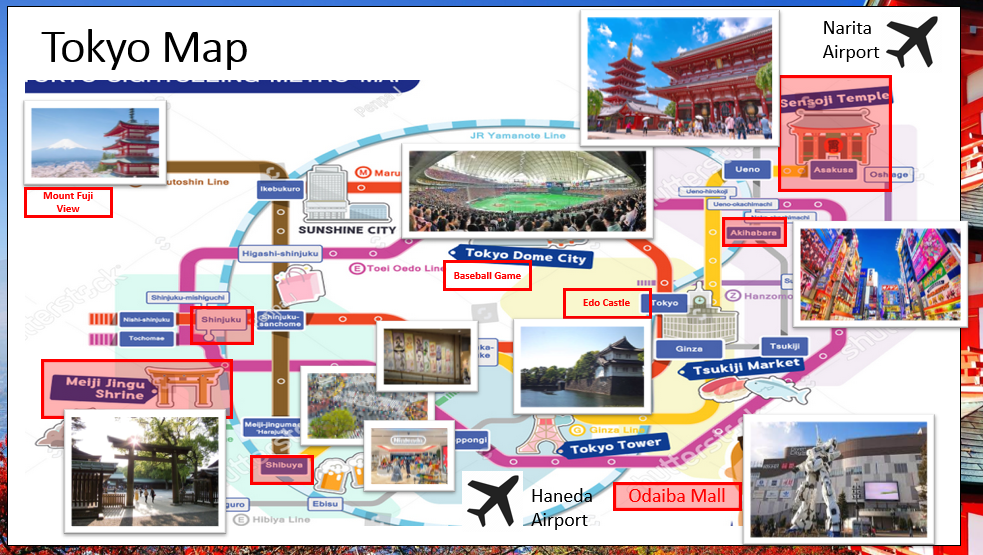
I call it the Circuit. Go around the circle and you’ll find something.

Must haves:

-Shibuya Crossing

-Shijuku Walkthrough and maybe, a show.

-Akihabara Stores

-Asakusa Temple

-A baseball game (Tokyo Giants or Yokohama Baystars)

Kyoto

image

Must Haves

-Fushimi Gates & Temple

-Old Kyoto District

-Golden Temple

Osaka

image

Must Have

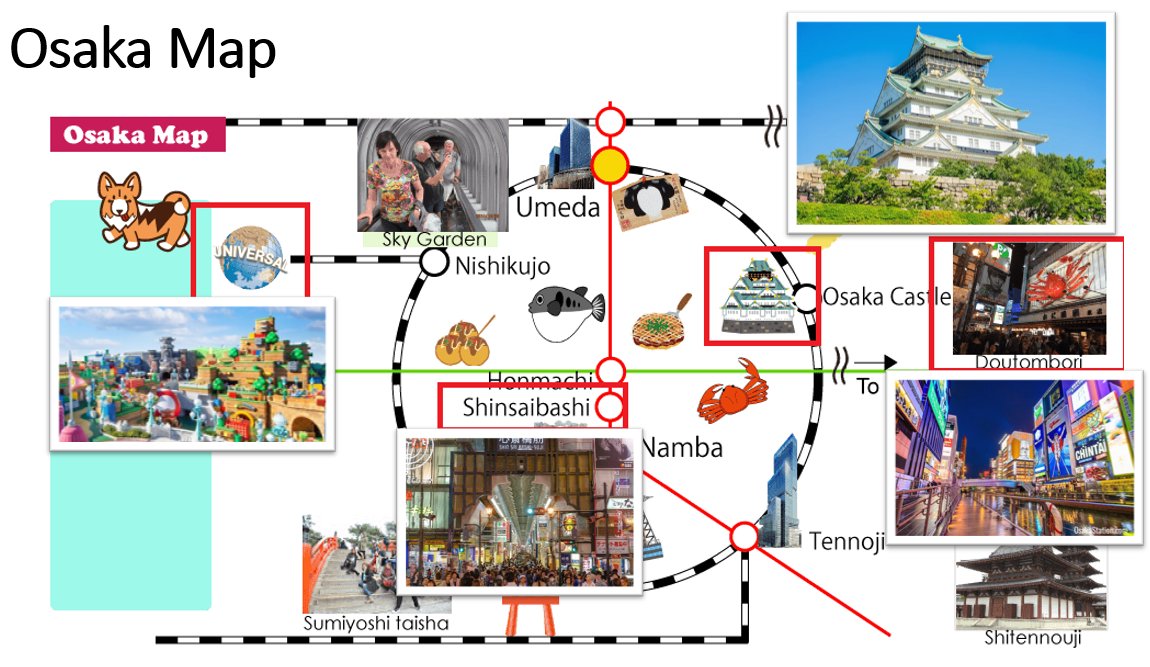
-Osaka Castle

-Doutombori (Notably Running Man Photo and Local Foods)

Okinawa

Must Haves

-Okinawa Aquarium

-Any beaches

-Hacksaw Ridge

How to leave to airport

When it’s time to head home, don’t screw around. Get to the airport early. Two hours before your flight is the bare minimum, and honestly, you’re better off padding it. Trains don’t care about your itinerary. Miss the express and end up on the slow one, and suddenly you’re sweating bullets while your plane boards without you.

My rule? Four hours. If the wheels go up at 2 p.m., I’m out the door at 10 a.m. Packed, fed, and ready for whatever chaos comes next. In Tokyo, that window saves you from stress. In Osaka, same deal—except don’t tempt fate by staying in Kyoto the night before. Stay in Osaka. The margin of error isn’t worth it.

Four hours gives you space. Time to get to the airport, grab a bite, wander duty-free, maybe sit with your thoughts—and yeah, maybe cry a little. Leaving Japan always feels like that. Then you board, buckle up, and let the trip fade into memory.

2004 – Germany

I was 24. Born May 1980 — right between Reagan and MTV, raised on processed food and Cold War fallout. By the time I landed in Germany, I’d been through Air Force tech school, had a rack at Keesler for nine months, and could fix a radio faster than I could figure out my own life.

I was living with my Korean family in Philadelphia — part sitcom, part survival. They loved me, in their own way. The food was good, and the expectations were heavy. I was stationed at Willow Grove, pulling full-time duty in a part-time war. Technically “on orders,” which is military-speak for “we need you, but not enough to commit.” I worked all day, went to school at night, and spent most of my time wondering who the hell I was supposed to be.

I was skinny, wired like a live cable, full of caffeine and ambition. The kind of ambition that doesn’t really know what it wants — just that it wants more. More than Lansdale. More than camo and chow halls and those sterile little rooms we called “billeting.”

I worked with the 270th Engineering and Installation Squadron — wire-pullers, radio riggers, the kind of people who actually kept the lights on when things fell apart. Blue-collar tech warriors. I didn’t have a grand mission. I had orders. And a plane ticket to Germany for two weeks of annual training — government-sponsored tourism with a side of gas mask drills.

I’d studied German for four years in high school. Never got to take the class trip. Couldn’t afford it. Watching other kids fly across the Atlantic while I bagged groceries or scraped together book money. Now, finally, I was here. Ramstein. Concrete and chain-link, bratwurst stands, beer colder than truth. It wasn’t Berlin. It wasn’t the postcard. It was real.

And maybe that was the point.

I didn’t know what I was doing with my life. I knew how to speak in radio code, clean a weapon, salute an officer, and bullshit my way through an enlisted man’s checklist. But I didn’t know me yet. Not really.

All I knew was: I was 24, in uniform, in Germany — far from Philly, far from the version of myself I used to imagine. And for once, that felt like enough.

130529-F-PY969-404
Ian E. Abbott

The trip started at Willow Grove — a sleepy little air station tucked north of Philly, more rust than glory, more Wawa than war zone. But it was ours. A place where part-time warriors like us punched in, suited up, and tried to make sense of two worlds: the civilian hustle and the uniformed grind.

We had a KC-135 ready to haul us across the Atlantic — an old tanker that smelled like jet fuel, sweat, and too many years of duct-tape solutions. Destination: Ramstein, Germany. Purpose: two weeks of annual training. Reality: a break from whatever mess we were trying to hold together back home.

From my shop, there were four of us going. Luster. Ransom. Myself. And… Whittiack? Something like that. He was the guy nobody really wanted there, but someone high enough up decided he was “mission essential.” There’s always one.

Luster and Ransom — they were my guys. Heroes, in their own way. We drilled together, ran cables together, bitched about the chow together. Ransom was up at Bloomsburg for school, still figuring out the civilian track. Luster, drifting somewhere in Philly, trying to find his lane but solid. The kind of guy who didn’t say much, but when he did, you listened.

We were young. Not invincible, but close enough. We were ready — or at least, Ransom was. He boarded the bird with a goddamn six-foot-long Subway sandwich like it was a tactical weapon. He knew something we didn’t. He had foresight. The rest of us? Starving halfway over the Atlantic, staring at him like wolves circling the last deer on Earth.

He broke off chunks of that sandwich like communion. Grudgingly generous. I think he still had two feet left when we hit cruising altitude. Nobody else brought a damn thing.

Whittiack — or whatever his name was — sat awkwardly, trying to wedge himself into our rhythm. He talked too much, said weird shit, asked questions no one wanted to answer. But he was in the seat, too. Headed to the same place.

At 35,000 feet, we floated above the clouds, strapped into that steel tube, joking, half-sleeping, not quite understanding the gravity of what it meant to fly to Germany in a uniform.

But we were excited. Giddy, even. Somewhere between military precision and barely-contained boyhood. We had orders. We had each other. And for a moment — somewhere over the cold Atlantic — that felt like enough.

UConn to play men's basketball in Germany.
Landstuhl_Regional_Medical_Center_(2008)
Landstuhl with Nanstein Castle at sunset

We touched down at Ramstein — the biggest patch of American soil in Europe without technically being America. Gray skies, the smell of jet exhaust, that military buzz in the air like something important is just about to happen. It never really does. But that feeling hums like power lines overhead.

They bused us over to Landstuhl — the hospital complex, the kind of place you don’t want to end up unless you’re visiting. It served the wounded, the sick, the dependents, the forgotten. A European lifeline for American uniforms. We weren’t there for the beds. Just the lodging. A barracks building they tossed us into for our two-week war vacation.

I remember staring out the bus window, watching the forest and old-world rooftops pass by, and daydreaming like I always did. What would it have been like to grow up here? To be a military brat with a mom who was a captain, a dad who was a major? Fluently bouncing between English and German, taking school trips to Paris like they were nothing, knowing how to drink by 14 and lie about it convincingly by 15.

But those were just daydreams. I wasn’t a lifer’s kid — I was a Philly transplant wearing someone else’s legacy on my chest. And I wasn’t single, either. Had a girlfriend back home. She knows who she was. I wasn’t here to chase women.

But my friends? Oh, they were hunting.

And we had one ace up the sleeve — me. Four years of high school German tucked in the back of my brain like a half-loaded magazine. Ich spreche ein bisschen. Enough to buy a beer. Maybe enough to help the guys get a phone number or two, if I played translator right. I didn’t make promises. Just smirks and shrugs.

We dumped our gear in the room — cold tile floors, government-issued sheets, and that subtle scent of mildew that never quite leaves. The kind of room that tells you, you’re not staying long… but long enough to forget your zip code.

The walk down to town was long — a winding road, lined with trees that had probably watched more airmen pass than anyone could count. We were broke. The per diem was a laughable eight bucks. The Euro was crushing the dollar like a bully stealing lunch money.

But we didn’t care. We were 24, in uniform, in Germany. We had feet, curiosity, and no real plan. And sometimes, that’s all you need.

So we walked down into Landstuhl — hungry, restless, wide-eyed. The night was waiting. And we were ready to meet it.

r039-image-Club-Ohlalaaa-Landstuhl
r370-interior-Club-Ohlalaaa-Landstuhl

We didn’t know where we were going — just that we had landed. Germany. Our first night. And like all young men with uniforms and too much testosterone, we followed the glowing lights and basslines into whatever the town had waiting for us.

The first place we found open? A damn strip club. Of course. Neon signs, promises in bad English, and the smell of smoke and perfume that never quite leaves your clothes. “Boys, this is it,” someone said — probably Ransom. And like fools, we walked in thinking this was going to be like back home. Toss a dollar, get a wink. A harmless dance and maybe a cheap thrill before calling it a night.

But this wasn’t the States. This was Europe. The rules were different. More expensive. Less forgiving.

We sat down and immediately learned the hustle. You didn’t tip a girl. You bought her a drink. Twenty-five bucks a pop. That was the game. Talk, flirt, smile, sip. They didn’t dance. They didn’t need to. They talked you out of your money — professionally, politely, and with laser focus.

These weren’t German girls either. They were Eastern European — Poland, Romania, maybe Ukraine. Young, beautiful, hard as nails. Eyes like glass. They knew we were easy targets. And we were. We came in with $8 a day per diem and big dumb dreams. The whole place was designed to extract every cent we had — and it worked.

Before long, we were broke. Our entire week’s budget bled out on overpriced drinks and soft promises. Ransom disappeared into a back room. The owner stopped me before I could check on him. “No boom boom,” he said. “Not unless you pay.”

The place had turned. The lights were still dim, but the illusion was gone. It wasn’t a bar. It was a machine. The girls were cogs. We were coins. I pulled the guys out with the oldest excuse in the book: “We’re going to the ATM.”

We didn’t go back.

Outside, Ransom laughed like he’d seen the face of God. “One girl tried to get me to pay $300,” he said. “Anything I wanted. All night. Even in the butt.”

For a broke airman who couldn’t get a second date back in Pennsylvania, that sounded like a dream. But for the rest of us, $300 might as well have been $3,000. We weren’t players. We were just dumb, horny kids trying to feel something.

I still felt responsible. I was the guy who spoke German. The “cultural expert.” The one who was supposed to navigate. So I led us down another road and found another place — a red light glowing faintly in the distance. That had to mean something. Right?

It was quieter inside. Softer. An older Asian woman — mid-40s maybe, maybe older — in elegant lingerie, approached us with a kind smile and a cold beer. A white ale. My first. Smooth, light, comforting. Like someone telling you it was going to be okay, even if it wasn’t.

She leaned in, said kind things, poured us more drinks. She wasn’t hustling, at least not as hard. Maybe she saw through the bravado. Maybe she was tired. Maybe we reminded her of sons she never had — or did. I gave her a few Euros for the jukebox. Let her pick the song. She leaned on my arm like we were old friends.

Older me would have handled it differently. Would’ve asked better questions. Would’ve tipped better. Would’ve known it was all a show, but still appreciated the kindness in the performance. But I was 24. In a relationship. Dumb and uncertain. She gave me something I didn’t expect — perspective.

Not sex. Not fantasy. Just a quiet reminder that the world doesn’t spin for your amusement. People are playing for keeps. This was her job. Her hustle. She didn’t care about our stories, our uniforms, our half-lives back home. She cared about survival.

We left, buzzed and broke, but not empty. I walked the boys back, navigating the turns like I’d been there before. I was the compass. The only one sober enough to see straight.

Tomorrow we’d wake up early, hungover, slightly ashamed, and slide into gas masks. Pretending we were soldiers. Pretending we were ready.

We weren’t. But we were learning.

woods
images
MOPP 3

Training. Of course.

They had to justify flying four hungover E-3s across the Atlantic on taxpayer money, so they gave us the usual theater. Chemical warfare. MOPP gear. Gas masks. Rubber gloves. The whole sweaty, suffocating ensemble designed to make you question every decision that led you to this point.

It was hot. It was boring. It was miserable.
And it was all bullshit.

We weren’t going to war. Not yet. We were just cogs in a peacetime machine that needed to look busy for someone up the chain. So there we were — half-alive, dehydrated, reeking of beer and shame from the night before, sweating in our charcoal-lined suits while some senior NCO barked about nerve agents.

We weren’t listening. Not really.

Our heads were still in Landstuhl. In that first bar. In that second bar. In that moment where someone leaned close, laughed at our jokes, and made us feel like kings — even if it was all for Euros. Back here, there were no smiles. No flirtation. Just layers of rubber and protocol.

There were no girls. No jukeboxes. No cold white ale.

Just dudes. Rows of them. Standing in formation, baking in black suits that smelled like old tires and regret. The air tasted like sweat and bureaucracy. We passed the time the way you do in the military — badly. Dumb jokes. Elbow nudges. Silent prayers that someone would call it early.

We wanted off this base.

We wanted cobblestone streets. Outdoor tables. The sound of German pop music playing softly through open bar doors. We wanted to be where things felt alive — not this sterilized military complex where time stood still and everything smelled like diesel and floor wax.

The training dragged on. And we endured it. Not because we cared, but because it was the price of freedom. If we did this — sat through the briefings, wore the gear, answered the checklists — then they’d cut us loose. Let us go to other parts of the base. Maybe even back into town.

We were 24-year-old kids in uniform, chasing shadows of adventure with lint in our pockets. But damn it, we were chasing something.

And that meant sitting through another hour of someone pointing at a diagram of a chemical burn while our minds wandered somewhere back to the red lights and the music and that first, cold beer.

images[1]
Trier_Marktkreuz_auf_dem_Hauptmarkt
tumblr_n2wxuvYAE11sivccmo1_1280
kaiserbrunnen_©_harald_kröher

The per diem was a joke. Eight bucks a day in Europe — barely enough for a schnitzel, let alone the night we wanted to have. But the military giveth and the military taketh away. What it didn’t pay in cash, it made up for in fuel. We had a government truck with a DoD gas card and zero oversight. Unlimited gas. Unlimited potential.

That truck was our lifeline.

As long as we refueled on base, we could go as far as time would allow. And so we did.

We drove to Kaiserslautern — K-Town, as the Americans called it. Old Germany wrapped in modern camouflage. Stone roads. Church spires. Dusty windows with neon beer signs barely lit. The kind of place where you could find something if you looked hard enough — or just got lost on purpose.

That first night, we just scoped it out. No wild plans. Just reconnaissance. We’d be back.

We still had work to do.

After our mandatory MOPP torture, they broke us up and assigned us to different corners of the base. I ended up with the comm squadron — the ones who kept the base humming with radios, cables, and quiet stress. Nothing glamorous. But I could speak the language — not just German, but the shorthand of switches and signal paths.

And there, I saw him.

A guy I knew from tech school. We’d shared barracks, beers, stories. Now, he barely looked up. He was stationed there full-time, settled into the grind. He didn’t need me anymore. Didn’t want to need anyone. I tried to catch up, crack a joke. He gave me the polite nod — the kind that says “I remember you, but I’ve moved on.”

It stung. Quietly. In that deep, familiar way rejection always does.
I wondered if I had been a bad friend, or just forgettable.

That was a powerful little truth to chew on while pulling Cat5 and taking orders from a crusty old TSgt who’d stopped caring in ‘98.

The week dragged like a loaded rucksack. Sleep. Work. Pretend. Drive. Rinse. Repeat.

Every day was the same. Every day we waited for Thursday.

The town was still out there. The beer. The music. The promise. The sense that something — anything — could happen. Friday wasn’t just a day. It was freedom. A permission slip to feel alive again, even if just for a few hours before sunrise.

And we were getting close.

7697764902

We came back to Kaiserslautern with a mission: to dance. To party. To forget about gas masks and per diem and the kind of existential rot that grows in barracks rooms with no Wi-Fi. I started searching for “dance clubs” in German — “tanzen” this, “tanzen” that — and all I found was a goddamn dance school. A place with mirrors and instructors, not drinks and poor decisions. That wasn’t the vibe.

So we pre-gamed the only way broke airmen can: with a pub crawl.

We hit every bar we could find that didn’t have a dress code or a cover charge. One of them stood out. Real colorful place. Clowns on the walls. Rainbows dangling from the ceiling like leftover party decorations no one had the guts to take down.

I had to piss — a few beers deep, riding that perfect buzz where you can still string sentences together but you’re on the edge. I stumbled into the bathroom, zipped down, and stared straight ahead like you do. Then I saw it: the flyer on the wall. Half-naked men. Glitter. Event dates.

Oh shit.

Gay bar.

Now look — I’m not saying it mattered. Not to me. But back then? With a truck full of 20-something airmen raised on testosterone and bad porn, this wasn’t going to land gently. Especially not with Ransom and Luster. Whittiack? Honestly, he might’ve been into it. Good for him if he was. But I didn’t stick around to workshop the conversation.

I zipped up and came back with that NCO tone in my voice: “Alright, time to move on, boys.”
No questions asked. Just clowns, beers, and one slightly confused exit.

We bounced between more bars, running into a crew of Army guys along the way. God bless the Army. Comrades in arms. Same bad haircuts, same cheap deodorant, same thirst for trouble. We drank like long-lost brothers. Poured stories into our beers and forgot who owed who a round.

Eventually, everyone got sloppy.

People forgot where we parked, where we were, what day it was. Except me. I remembered — somehow — that we left the truck by an Aldi. That little miracle of memory might’ve been the only reason we didn’t end up arrested, missing, or face-down in some ditch on the edge of town.

As we made our way back, an older German couple started walking with us — drunk, friendly, just as lost in the night as we were. The woman? She was very friendly. Started groping us, one by one, laughing like it was some kind of twisted game show. She grabbed my ass. I think. Or maybe someone else’s. Hard to tell. But no one stopped her.

We let it happen. Maybe for the attention. Maybe for the story. Maybe just to keep the weirdness rolling.

I loaded the guys into the truck like a clown car full of military dysfunction. Dropped off the Army boys at their base. Swapped phone numbers we’d never call. Said goodbyes that felt way too meaningful for people we’d just met.

Then Friday hit.

We found the club — A6. The one people talked about. The name sounded like a European highway and it kind of was — a direct road to disappointment. I thought it’d be German techno, pulsing bass, fog machines, and glow sticks. But it was just another American outpost. Fluorescent Bud Lights. Military ID checks. That same damn Nelly song playing on repeat.

It catered to the American need to feel cool while being surrounded by people just like them.

There weren’t many locals. Just us. A beer or two in, we realized this wasn’t going to lead anywhere. No love stories. No legendary hookups. Just sweat and bass and that creeping hangover lurking in the corners.

We danced a little. We stood around more. We called it.

Sleep won.

1358019750e818c22815b55cf2874808b732350081_eins
bitburger-erlebnis-welt
spangdahlem-air-base

We had a truck. That was our freedom. Our escape pod. No one cared where we went, as long as we fueled up on base and didn’t crash it into a castle.

Back then, navigation wasn’t an app. It wasn’t a voice telling you when to turn. The only map I had was tucked into the back of my dog-eared German-English dictionary — a single-page layout of highways and cities I couldn’t pronounce. No GPS. Just instincts, road signs, and a good guess.

Our phones? Nokia bricks. Good for Snake and not much else. No Google Maps. No real-time traffic. Just the open road and some dumb confidence.

But I loved it. That feeling of not knowing exactly where you were — and not caring. I became the default driver. The guy behind the wheel. The one who paid attention to the way back. The compass. That’s what I gave the team. Not swagger, not jokes, just the guarantee that we’d get home safe.

So we headed north.

Out of Ramstein, up the Autobahn — that mythical road where speed limits are optional and everything looks like a postcard. We passed through the kind of places that felt older than memory. Mountains. Fog. Slate rooftops. Towns that looked like they hadn’t changed in centuries, just quietly enduring between valleys.

We rolled through Bitburg. That name meant nothing to me at the time — just a blur on the side of a road, a brewery we didn’t stop at. But it stayed in my head. The logo. The signage. The way the town looked like it knew something I didn’t. Years later, Bitburger would become one of my favorite beers, and I’d trace it all the way back to that drive.

Trier came next — old Roman city, history crumbling into cobblestone. We parked and walked. Not much money to spend, just broke airmen window-shopping through a thousand years of culture. But sometimes, that’s all you need. The smell of street bread. The sound of a foreign language you almost understand. The feeling that you’re somewhere else — really else.

On the way back, we swung through Spangdahlem. Another Air Force base. Clean. Tidy. Game room. Commissary. Everything you wanted, if you didn’t care how sterile it all felt. It was a good fallback — a place to tuck away in your head for a rainy day. I filed it under “escape routes” and moved on.

By now, though, we were really getting sick of Whittiak.

Every group’s got one — the guy who doesn’t get it, doesn’t vibe, doesn’t know when to shut up. He wasn’t a bad guy. Just… out of sync. Like a wrong frequency playing in the background of a song you liked. You start to tune it out at first. Then it starts to ruin the song.

The road back was quiet. We were tired. But it was the good kind of tired — earned, not wasted.

We had miles behind us. Mountains in the rearview.
And tomorrow, we’d do it all over again.

The Spangdahlem Air Base main gate is shown in Mar
commisary
150410-F-LX214-040

I tried to get us on the trains. Thought it’d be the “European thing to do.” Rail passes. Gliding past castles with a baguette in hand, like some backpacking daydream.

But German trains weren’t built for broke American airmen with $8 a day. Too expensive. Too confusing. No Google Maps, no apps, just paper timetables and words with way too many syllables. Driving? Still king. At least behind the wheel, I had control. I had a mission.

But something else had to go.

Whittiak.

Our fourth man. The tagalong no one invited. Annoying in ways that didn’t make sense until you spent five straight days with him. He didn’t do anything — just existed wrong. Off-beat. Loud in quiet moments. Quiet when you needed him to speak. The kind of guy who made a three-person trip feel like a group therapy session.

So we hatched a plan.
Ransom. Luster. Me.

“Meet at the truck,” I told Ransom. “We’re rolling out. Just us.”

Luster was already in the passenger seat, engine running like a getaway car. Ransom? Still in the barracks, trying to shake off Whittiak like gum stuck to his shoe.

Then I saw it.

Ransom, full sprint — the kind of run that says “I’m not missing this.”
Right behind him — Whittiak, giving chase like some sad, determined villain in a low-budget buddy film.

Door open.
Ransom dives in.
And just like that — SLAM.

Rearview mirror: one confused, breathless Whittiak left standing in the dust.

And us?

Free.

It felt like parole. The air was lighter. The jokes hit better. The truck was finally ours — back to the core three. No weird commentary. No sighs. No dragging weight. Just laughter and purpose.

With that freedom came obligation. I wanted to give them a good time. I wanted to make the most of the trip. So I did what any broke-ass, guilt-ridden navigator would do — I drove us back to Spangdahlem.

Not glamorous. But it worked.

The base was quiet. Clean. Familiar. It had a game room with those old-school arcade cabinets that made you forget where you were for a second. Games where nothing mattered but timing and reflex. We blew off steam. Laughed like kids again.

I walked the commissary alone for a while — shelves stacked with the comforts of home. Cereal boxes. Doritos. BBQ sauce. Little pockets of America, shipped across the ocean for the homesick and hungry. It was weirdly beautiful. A reminder that someone, somewhere, wanted to make life livable for the uniformed.

And in those quiet aisles, I thought about things.

About how I probably should’ve gone active duty. About how this life — the structure, the purpose, the clarity — felt good. Clean. Predictable in a way civilian life never was. But I had a girlfriend. College plans. Officer dreams. There was no online school back then. No remote anything. You went all in, or not at all.

So I chose “not at all.”
But I still wonder.

The boys? They were happy. I kept them entertained. Navigated. That was my job — unofficially. Spirit guide with a gas card.

And on the drive back to base, the radio crackled with the songs of our trip. The strange, now-sacred soundtrack of Germany 2004.
O-Zone’s Dragostea Din Tei
And Black Eyed Peas: “Let’s Get Retarded.”

Yeah — the German version still said it. No edit. No apology.
America hadn’t found its sensitivity yet. Not entirely.

But that was our trip in a nutshell.
Dumb, reckless, unforgettable.

Just three guys, a truck, and a little breathing room before life got serious again.

blarney-stone-irish-pub
photo2jpg

All adventures end. They always do.

The McDonald’s in town — our sad little reward for surviving another chow hall mystery meat. The long walk back along the train tracks, beer in our breath and gravel crunching under our boots. That little taste of freedom, of pretending we weren’t just on orders in a foreign place where everything still felt like a movie.

It was winding down.

But before we flew out, we needed to mark the end properly. One last night. One last bar. And wouldn’t you know it — Whittiak had a suggestion.

The Irish pub.

Of course it was his pick. After all the silent eye rolls, all the heavy sighs and tactical avoidance, we still had to forgive the guy. We ditched him. Maybe it was cruel. Maybe it was justified. Either way, we needed a peace treaty. And we needed drinks.

I half-fantasized about driving to Berlin that weekend — really going big, making it count. Or Paris. That sounded cinematic. Three airmen in a truck beneath the Eiffel Tower. But the gas logistics alone made it impossible. We were dreamers with military ID cards and ration cards, not international men of mystery. So, we stayed.

We did what we did best — drowned our thoughts in cheap beer in a dimly lit pub filled with expats and karaoke ghosts.

And then she appeared.

A heavyset Irish-looking woman. Limping. Clearly a few pints in. She waddled up to us — eyes glazed but determined — and said it, clear as day:
“Do you know someone who’d fuck me?”

We blinked.

No flirtation. No warm-up. Just that.

Was she serious? Absolutely. Was I? Absolutely not.

But there she was — human, loud, drunk, and craving something primal. Something transactional. Some crumb of affection in the bottom of a pint glass. And us? We were assholes. We laughed. Made a few crude jokes. Pawned her off to Whittiak like it was some kind of poetic justice.

She wanted sex. We wanted out. Nobody said yes.

I think about her sometimes. The desperation. The rawness of it. It’s easy to mock people when you’re young and stupid and feel untouchable. But maybe she was just another person needing a connection — no matter how messy, how absurd, how fleeting. Who were we to judge?

We finished our drinks and left the pub a little quieter.

The next morning came too early. We boarded the KC-135, the same old bird that brought us out here. Tired. Hungover. Different. We had a layover at Mildenhall, England — another blur of flightlines, vending machines, and waiting. Like a limbo between adventure and home.

No clowns. No jukebox girls. No strip club swindles. Just a long runway and the slow march back to normal life.

We didn’t say much. You never do at the end. The fun’s over, and the silence becomes your way of honoring it.

We came. We saw. We got hustled. We laughed.
We ditched a guy and drank with the Army.
We rode the Autobahn and flirted with trouble.
We were jerks, but we were honest about it.

And somewhere in Germany, there’s still a pub, a road, a cracked beer bottle, and maybe even a woman with a limp — all part of our story.

That was our trip. And we made it ours.

british Mcdonalds
Mildenhall AFB

Our final stop before home was Mildenhall Air Force Base. England. Technically. A brief layover on the tail end of our budget saga across Germany. But for me, it meant something.

“I’ve been to Britain.”

It didn’t matter that we never left the wire. That we didn’t see Big Ben or sip warm beer in some pub with peeling wallpaper and pissed-off bartenders. We were there. Boots on British soil. I logged it mentally, like a passport stamp I’d never actually get.

We were all still itching for one more adventure — one more dash off base, just to say we lived it. But there wasn’t time. Just the slow churn of processing through, scanning IDs, waiting for instructions that never came fast enough.

So we made do with what we had.

Our last meal in Europe? McDonald’s.

And I wasn’t mad about it. I wanted to see what it was like — the small, strange ways cultures bend around the golden arches. The menu looked familiar, but not quite. Fries the same. Coke the same. But that sticker shock?

The combo meal ran me 12 bucks.

Back home it was six. Maybe six-fifty. But here? With the USD to pound exchange rate doing its worst, I paid double to taste the exact same thing. A powerful lesson. The price of comfort abroad is always more than you expect — whether it’s in pounds, Euros, or a half-spent per diem.

There were no more six-foot subs. No last-night debauchery. No dramatic airport goodbyes. Just a long flight, sore necks, and the hum of engines that lulled you into memory.

We landed. We were back. Willow Grove or wherever home was that week.

The adventure ended, like they always do — quietly. Without ceremony. Without fireworks. You just step off the plane, blink at the sunlight, and realize the story’s over.

But even now, sometimes, Ransom, Luster, and I still laugh about it.
About the sandwich.
About the bar with the rainbows and clowns.
About ditching Whittiak like a bad dream.
About the drunk German couple and that poor woman in the Irish pub.
About three broke airmen chasing adventure in the shadows of old castles.

It wasn’t glamorous. It wasn’t well-planned. But it was ours.

And sometimes, that’s all you need.

We still have song in our head.

2015 – Denmark

Coming off a dusty run through the Middle East and a frosty layover in Finland, I landed in Copenhagen feeling like a ghost. That kind of jet-lagged, soul-hollow loneliness that creeps in somewhere over the Atlantic and tightens its grip with every hour. I missed my kids. A dull ache, like background noise. I missed my wife too—at least the parts of her that didn’t involve passive-aggressive jabs over the dinner table or phone call. I didn’t miss the complaining.

This trip wasn’t for pleasure. I was here on reconnaissance—scouting the city like a war correspondent casing the front lines of future holiday cheer. Years ago, when she was still chasing degrees and idealism, she’d done a school project on Christmas in Denmark. She remembered it fondly. I remembered her face lighting up when she talked about it. So, maybe I could bottle that memory, repackage it as a trip for the kids. A gift. A gesture. Maybe even a peace offering.

I stepped off the plane and into the cold light of the Copenhagen airport. Bone-tired. Out of place. But here.

20150316_201042
20150316_201049
20150316_201056

The taxi ride in was, surprisingly, a lift. Copenhagen—neatly pressed, bicycle-polished Copenhagen—has this undercurrent most tourists never see. A pulse of Arab and Turkish families carving out a better life beneath the postcard-perfect surface. My driver was Syrian. We talked. Not small talk—real conversation. Dubai came up. Its food. Its excess. Its lights. Places he’d been. Places I’d passed through like a shadow. I made sure to tip him well.

I mentioned, vaguely, that I worked with cell towers. I never tell anyone what I actually do. Not really. That story’s for me.

He dropped me at a hotel I booked for fifty bucks a night. Not a hostel—never. I had gear. A camera. A tripod that cost more than the room. Rick told me to buy it. Said I’d thank him one day. I think I did. Maybe not out loud.

I brought lenses too—more ambition than talent, but I was determined to shoot something. Anything. The city. The streets. A bowl of soup that meant something. I wasn’t just here to decompress from the brutal rhythm of 13-hour days, seven days a week—I was here on recon. Could this city carry a Christmas for the kids? For her?

The hotel was exactly what you’d expect for the price. Basic. Sparse. No soul. But that was fine. I wasn’t here to be comfortable. I was here to remember what it felt like to be a person again.

20150316_181526
20150316_173559

I checked into the hotel and didn’t waste time. Grabbed my gear and hit the streets—camera slung, tripod under arm, chasing that last hour of light. The kind of light that makes cities look honest.

Copenhagen isn’t loud about what it is. It just is. Clean streets, endless bikes, and a walking culture that makes you feel like a slug if you’re not moving. But beneath the polished veneer, there’s a smirk. A sense of humor. Somewhere between charming and obscene. Did I just pass a piece of public art shaped like a dick? Yeah. I think I did. And no one cared. No pearl-clutching. No fences. Just… there. Bold. Unapologetic.

Maybe that’s the thing about this place. You’re allowed to be free—as long as you don’t ruin it for anyone else.

The sun was dropping fast, and I was still hunting. That golden hour was slipping. I made it just in time—just before the last rays dipped below the rooftops and the harbor turned from postcard-perfect to something quietly cinematic. Click. Click. Silence. It was good.

IMG_3346
IMG_20150317_030708

There I was—hunched behind the camera like a wannabe auteur, manually dialing in the shot. ISO, exposure, shutter speed… the quiet language of control in a world that rarely gives it to you. I was still fumbling through F-stops like a kid learning to drive stick, but I knew what I wanted: no blur, no bullshit—just a clean, honest image of something that mattered.

Nyhavn. The harbor. Painted homes lined up like candy-colored soldiers. Touristy, sure. But there’s a reason people come here. Today, I wasn’t just another set of feet on cobblestones—I was present. This moment was mine.

I framed the shot to get every shade of yellow, blue, and red. It wasn’t just for me, of course. Part of it was for the crowd. The digital crowd. The ones who need to know you’re still out there, still moving, still living some curated version of a life worth envying.

20150316_182352

The sun dipped. The sky lost its warmth. I packed up the gear, hauled it back to the hotel like a mule carrying glass, and dropped it with care. Then I Googled Thai food in Copenhagen—because sometimes, all the Michelin stars and Nordic fusion in the world can’t beat the comfort of fish sauce and chili.

And I walked. Quiet, content, alone.

20150316_184741

I was alone.

Not the kind of alone that feels cinematic or noble—but the kind that wraps around your ribs like a cold hand. I’d been a good boy. I didn’t chase temporary pleasure, didn’t go looking for a warm body to erase the ache. But sometimes, it came anyway. Flirtation with no future. A compliment in broken English. A glance too long. I was flattered—but I stayed seated, alone, at a small table with a tall pilsner and my usual: Thai curry. Always the curry.

As the spice hit and the beer cooled my tongue, I made a silent promise to myself: never again like this. No more solo pilgrimages where I pretend it’s all for the photos. My wife would never come here. Outside of Italy, her passport collected more dust than stamps. Later, I’d come to understand why—anxiety. The kind that drains the joy out of airports and makes even the idea of adventure feel like a threat. My 15-year-old had the same storm brewing inside. I recognized the signs—the fidgeting, the dread, the need to retreat.

I was with the wrong person.

The woman I married—the one who once made me laugh, who danced drunk under fireworks—she wasn’t that person anymore. We were becoming strangers with matching tax forms. I was out here building a future, making money in cities I could barely pronounce while she was still trying to find herself after the Navy. But she didn’t find herself alone. She found someone else. While one kid stayed at my mom’s, the other stayed with her—and her plus one.

I didn’t know the whole story yet. But the breadcrumbs were already there.

The curry was good. Comforting. The kind of meal that doesn’t ask questions. I paid, walked back through cold Danish air, and crawled into a hotel bed built for one.

I missed my family. Not the one I had, maybe, but the idea of what it could’ve been. I queued up Esta Tonne’s Golden Dragon—that haunting guitar I’d first discovered on a lonely train ride somewhere in Europe. It had become my soundtrack for solitude.

And I slept. Sort of.

20150317_065206
20150317_072331

Sleep didn’t stick. Maybe a few hours. That kind of restless hotel sleep where your body’s horizontal but your mind’s still pacing. I was heading to Kiel, Germany next—but first, I needed one more walk. One more reason to stretch my legs before checking out of another room that held nothing for me.

I had a mission. Somewhere online, I saw a picture—giant concrete elephants standing guard outside the old Carlsberg brewery. Not just beer mascots—monuments. Odd, surreal, and a little majestic. They stuck with me. I knew I had to see them for myself. So I walked. A few miles through waking streets. No map, just the quiet pull of intention.

When I finally reached them, there they were. Massive. Strange. Beautiful in that industrial, European way. I took the shots. Carefully. Patiently. It felt worth it.

Because for years, I wasn’t allowed this. Travel had been rationed out in teaspoons. A trip here, a weekend there. But I wanted the whole goddamn meal. The freedom to disappear into cities, to eat new food, to photograph something no one else I knew had seen.

Later, I’d realize this wasn’t just a detour. This was survival. A way to breathe before going back home to an ex-wife who didn’t know how to stop arguing, who didn’t know how to listen, or offer softness when I needed it most. She didn’t decompress me—she crushed me. I needed tenderness. I needed stillness. She gave me static.

So I bottled it up. Like a coward or a man with no other option.

I drank. I laughed too hard with friends who knew something was wrong but didn’t ask. I drank some more. It was unhealthy, sure. But it worked—until it didn’t.

And now? Now I walk through foreign streets chasing elephants and shadows, camera in hand, trying to get back to myself. One photo at a time.

20150317_094438
20150317_123612
20150317_132724

Checked out. One last look at the sterile hotel room, the crumpled sheets, the camera gear now repacked with surgical care. I headed to the station, bought a ticket the old-fashioned way. No drama. No overthinking. Just a train, a seat, and a window with miles of unknown spilling past.

This was the part I craved—watching the countryside roll by like an old film reel. Open land. Fences. Farmhouses. Pockets of stillness where people lived entire lives without ever needing to explain themselves.

Somewhere along the ride, I thought about her—an ex-girlfriend. She knows who she is. I won’t name her. Not out of drama, but respect. She studied here once, years ago. A foreign exchange trip full of wine, rebellion, and stories that made my brow twitch when she told them. But she needed it. We all did, in our own way. Her hosts showed grace. She learned the language. Became part of the landscape for a while.

She’ll probably shoot me a message when she hears I passed through—maybe with a story too wild for text. We’re on good terms. Most of them are. There are only a couple I’ve exiled from memory. Not out of heartbreak, just… preservation.

On the train, I cracked open a beer. One of those tall cans that pairs well with movement and silence. A guy sat next to me—no words, just a nod. Maybe he thought I was local. Maybe he didn’t care. We just drank together. Strangers. No names. No agenda. A quiet ritual in a moving box of steel.

Eventually, the train slowed. Kiel.

I had a bed waiting. And a friend I hadn’t seen in too long.

Germany would be different. It had to be.


2004 – South Korea

Back in the early 2000s, I signed up with the Air National Guard out of Philly. Not out of some grand patriotic fever, but because I needed out—out of central Pennsylvania, out of the small-town gravity pulling me under. I wanted an education. And maybe, just maybe, a shot at something bigger.

I won’t name names here—that part of the story isn’t mine to expose. But I ended up living with a Korean family. Kind people. Generous. They opened their home to me, no questions asked. Maybe they pitied me. Maybe they saw something worth saving. Or maybe I was just another lost American kid showing up hungry and half-formed. Doesn’t matter.

What matters is they treated me like one of their own. And then something wild happened: we traveled together. A family trip. Abroad.

Now for a guy who grew up watching overdue bills pile up on the kitchen counter, a trip overseas wasn’t something that happened. It was something you saw in movies, something that happened to other people—people with frequent flyer miles and dinner reservations.

But there I was, passport in hand, with people who barely knew me, flying thousands of miles away from the only life I had known.

It wasn’t just a trip. It was a kind of salvation.

korea
seoul 2004 -1
Seoul apartments
seoul 2005

Second time out of the country. Second time in South Korea. I didn’t know what to expect, but I knew one thing—I felt safe. Traveling with the Korean family gave me a kind of grounding I hadn’t known before. They trusted me. And in return, I trusted them.

Korea in the early 2000s felt like the U.S.—just… a decade behind. A country still stretching its legs after being broken by war, trying to catch up without forgetting what it’s been through. And make no mistake, the war never ended. Just a ceasefire. A breath being held for fifty years. The line between North and South still watched, still dangerous. Seoul, vibrant and sprawling, lives with the hum of that tension. A city with a sword hanging over it by a thread.

We started there—like many families do. My Korean family had left years ago, but this was a return. A kind of pilgrimage. The old man—he needed the air of home. He’d done his time. Literally.

He told stories. Not the sanitized kind. He’d been brash. Angry. Probably scared, too. Like every conscripted kid from a poor neighborhood who gets handed a rifle and a death sentence. In Korea, service isn’t optional. But class? Class decides whether you die in the dirt or shine your boots behind a desk. Rich kids got sent to the rear. Poor kids got swapped out, reassigned, and thrown forward. Games played with serial numbers and signatures.

The old man got the front line. Gunner on a chopper. Black ops over the border. He talked about the gun—how it tore through people like paper. He said it with a kind of weight I’d seen in the eyes of old vets back home. A knowing. Not pride. Not shame. Just the kind of truth you carry when you’ve seen the worst in men—and in yourself.

I respected him. More than that—I needed him.

He was the kind of father I didn’t know I was missing until he showed up. Tough, but warm. Scarred, but whole. He gave a damn about me. Gave me structure. And for the first time in a long time, I felt what that was like.

I loved him. I loved them. And in that moment, halfway across the world, I wasn’t lost. I was home.

7697734902
koreanbbq in korea
KoreanDrinks

The adults did what adults do—sat around tables, poured drinks, swapped stories in low tones. Left to ourselves, the kids—us—we were cut loose.

My cousin, or something like a cousin, took charge. He was the type who knew the city and how to bend the night in his favor. He brought along his buddy from construction—rough hands, easy grin. The kind of guy who works all day, drinks all night, and knows when to laugh.

We hit the streets. Neon washed over us like rain. We talked. We drank. I listened more than I spoke. There was something about hearing your life mirrored in another tongue, in another place, that made it hit harder. These weren’t just drinking buddies. This was a window into another life.

My cousin had plans. Big ones. He was headed to the States for school. The pressure of Korean parents is no joke—he wore it like a second skin. An American degree meant respect, escape, maybe even happiness. He didn’t say it out loud, but I knew the weight he carried. We all carry it differently.

We promised to write. I didn’t. Life moves. Distance grows.

But that night, we laughed like the world outside didn’t matter. Like the border up north wasn’t humming with tension. Like responsibility could wait.

Just for one night, we were kids in a foreign land, drinking like locals, dreaming like fools.

And it was beautiful.

Busan2004
Busan Love hotel

Like every family, we did the most universal thing you can do when you’re packed into a van with people you love—hit the road.

We drove south, deeper into the spine of Korea. Destination: Daejeon. A city that doesn’t make it onto postcards or tourism campaigns, but that wasn’t the point. I think it was where Korean mom’s family came from. We were visiting a sister? A brother? Memory’s a little foggy on that one.

What I do remember, clear as a soju bottle at midnight, is being the first white guy they’d ever seen in real life. Not in movies. Not on game shows. A flesh-and-blood American, standing awkwardly in the doorway like a walking culture shock.

They stared. I smiled. And honestly? I didn’t blame them. This wasn’t Seoul. This wasn’t near a base. This was the real Korea—unfiltered, unscripted, and unconcerned with who I was.

I was honored, but didn’t make a big deal of it. I was a guest. You show up, you eat what’s offered, you smile, you shut up.

Then came Busan. That’s when things got… interesting.

The old man, ever the practical warrior, booked us a cheap hotel. Frugal to a fault. Except this place wasn’t just cheap—it had a very specific clientele.

A love hotel.

I should’ve known when I walked past racks of VHS porno tapes on the way up the stairs. That kind of neon-lit sadness you can’t unsee. This wasn’t a place for families. This was a place for… transactions.

Korean mom? I think she was horrified. Or maybe not. Maybe she knew and just didn’t say anything. Sweetest woman I’d ever met—wouldn’t put it past her to just endure it for the sake of the trip. Either way, I didn’t ask.

My room? It had a bed. Circular. Vinyl. Hard as a rock. A bed made for thrusting, not resting.

I got a call shortly after settling in—just to check if I was okay. I was. More than okay, honestly. I was alone. In a foreign city. In a room designed for one-night stands. And somehow, I slept like a baby.

The best part? The old man and I couldn’t stop laughing. Days later, we’d still bring it up—crack jokes in the car, mid-meal, out of nowhere. That hotel became legend. Our little shared absurdity on a trip full of memories.

Sometimes, it’s the weird stuff that stays with you the longest.

And God, do I miss that laugh.

Sejong_tomb_1
Sejong_tomb_2

We woke up and did what you do when you’re trying to make the most of a morning in a strange city—you go see the dead.

Royal tombs. Not tourist traps or carnival rides. Just these massive grassy mounds, quiet and solemn, set apart like sacred punctuation marks on the Korean landscape. Buried royalty, untouched and revered. You could feel the respect in the air. No trash, no shouting kids, no selfie sticks. Just reverence.

It was my first time standing in front of anything that old, that regal. I didn’t know the names. I didn’t know the dynasties. I wish I did. Korean history—at least where I grew up—wasn’t something we were taught. It was glossed over in favor of more familiar faces. More comfortable stories.

But standing there, even with a blank slate, I felt it. The weight of a civilization that’s been through war, invasion, occupation—still standing. Still remembering its kings.

You don’t have to know the full story to feel the page you’re standing on is important. I just wish I’d read more before I got there. Maybe I would’ve bowed a little deeper.

Checkpoint

When we were heading north when it happened—an unexpected detour into reality.

Checkpoint.

At first, I didn’t get it. I thought maybe it was some traffic thing, or a toll, or a random inspection. Then it hit me. This isn’t just a country with a tense history. This is a country still technically at war. The Korean War didn’t end. It just hit pause. And those checkpoints? They’re not decoration. They’re designed to catch the bad guys. The ones who don’t belong. The ones sneaking in from the north.

What they caught instead… was us.

Turns out, the old man and my Korean family members weren’t exactly “cleared” to be behind the wheel in Korea. No licenses. No paperwork. Just vibes.

But me? I had this flimsy little AAA-issued international driver’s license. A joke in most parts of the world. But right then, it made me the most legal person in the vehicle. A white American kid with the power of laminated plastic and dumb luck.

The old man, never one to miss an opportunity, spun a quick tale. Told the officer I was tired, overworked, too worn out to drive. We smiled. We nodded. We lied beautifully.

Next thing I knew, I was in the front seat. Behind the wheel. Me—driving a Korean minivan full of people, heading north toward the DMZ, technically saving the day with my questionable credentials and a straight face.

We laughed about it the whole way. The old man kept shaking his head, grinning like a fox.

For once, I wasn’t just tagging along. I added something to this trip. I mattered. And damn, did that feel good.

Northbound, baby. Me driving. Hah. What could possibly go wrong?

Korea-Seoraksan-Buddha-Statue-02
Deoksugung
1024px-Korea-Sinheungsa-Bojero-01
Geungnakbojeon_at_Sinheungsa_03

I grew up with martial arts. American-style. Chopsocky movies, dojo mats that smelled like old socks, and this vague, romantic idea that anything Asian was somehow… sacred. Mysterious. Holy.

So when I stood at the base of that towering Buddha at Sinheungsa, nestled in the Korean mountains, I felt it—that same childhood awe. Monks in robes. Prayer wheels spinning in silence. The kind of setting that made you believe you were just one whispered mantra away from becoming a kung fu master or unlocking some kind of inner peace.

Of course, I found neither.

No secret scroll. No enlightenment. Just me—an American kid standing in front of an ancient statue, trying to feel something profound.

And yet, I appreciated it. Deeply. Not because it changed me, but because it didn’t have to.

7697744902

Sinheungsa didn’t owe me a transformation. It just was. A place older than my country. A place where people actually lived out the beliefs I’d only seen on VHS tapes and half-read books.

Then the old man—because he always had a story—leaned in and ruined the moment in the best way possible.

Told me about his time up in the mountains as a chopper gunner. Said when they needed firewood, he’d just point the machine gun at a tree and rip it down.

Firewood by way of automatic weapon.

Of course that’s what he did. Why wouldn’t he?

And just like that, the sacred and the absurd coexisted. That’s Korea. That was my trip. That was life.

A giant Buddha in the mist… and a guy cutting down trees with a belt-fed M60.

jejudo -1
Parnas Hotel Jeju 2
7697724902

We made our way back to Seoul, winding down the mainland miles behind us. But the trip wasn’t over—not yet.

Next stop: Jejudo. South Korea’s southern gem. Locals call it the Hawaii of Korea, and I get why. Volcanic landscapes, black sand beaches, waterfalls that look like they were carved out by a painter’s brush.

It was off-season, though. No tour buses clogging the roads. No honeymooners snapping photos every two steps. Just quiet.

That’s how the old man got us a deal. He always got the deal.

We checked into a resort hotel—one of those places built for crowds that never came this time of year. The halls echoed. The pool sat still. A few other families scattered around, but for the most part, it was ours.

For the parents, this was paradise. Peace. No schedules. No noise. For us younger ones? It meant no wild nights, no real partying. But I didn’t mind. I wasn’t much of a drinker yet anyway. Still figuring out who I was, what I wanted.

So we did what travelers rarely allow themselves to do.

We rested.

We took in the wind. The sea. The strange feeling of being far from everything familiar, yet somehow right where we were supposed to be.

It wasn’t loud. It wasn’t crazy. But it was needed.

And sometimes, that’s the best part of the journey—the quiet between the chaos.

folks village
Bonsai 2

Jejudo wasn’t just beaches and rest. It was a window—cracked open just enough to glimpse something older. Something deeper.

We visited a folk village, one of those places that smells like history and woodsmoke. Worn tools. Stone walls. People in hanbok showing how life used to be lived before glass towers and bullet trains.

Then there was the bonsai garden—a quiet, sacred kind of place. Twisted little trees shaped with obsessive care. Centuries of patience in every branch. I remember staring at them, wondering if I’d ever master anything in my life with that kind of focus.

And of course, the mushroom tea factory. Earthy. Bitter. Packed with promise—healing, energy, whatever the label said. I drank it like medicine, even if I didn’t know what it was supposed to fix. All the right things to do on vacation. The checklist stuff. But somehow, it didn’t feel forced. It felt earned.

We only had a few nights on that island. But I remember it all.

I remember hearing about the Jeju women divershaenyeo, they’re called. Elderly women who free-dive without tanks, plunging into cold waters to harvest shellfish and seaweed. No fear. No drama. Just tradition and grit passed from mother to daughter, for generations. These women were warriors in wetsuits. Icons of resilience.

Then, like all good things, it ended.

We flew back to Seoul. But Jejudo stayed with me.

Still does.

Neneverneverland4
Neverneverland2
neverneverland1
Neverneverland3

We flew back to Seoul. The parents went somewhere. We forget. But our cousin will take us to an amusement park. We went to Never Never Land. It’s the Disneyland rip off that had all the same quirks, songs, and rides, but without the disney price. I really enjoyed this experience. I miss it sometimes. It was a special moment where we made memories. This is somewhere I’ll never probably take my family, but still. It’s a nice place. Wrapping up the trip with a few more drinking places back in Seoul, I’ve enjoyed this trip.

We flew back over Japan.

I looked down through the scratched airplane window and quietly promised myself I’d get there one day. Japan was where I really wanted to go. The dream. But life—well, life handed me a detour. A strange, beautiful, unforgettable detour.

And it gave me something I didn’t know I needed.

I was becoming a little more Korean. Not in blood, but in spirit. In rhythm. In ritual. In understanding. I was laying down roots that would help me grow into the man I eventually became. Stronger. Wiser. A little more patient. A little more grateful.

And then, like a lot of things in life, it ended in a way I didn’t want.

Then it happened. An event that was a major decision. A private one. They know. She knows. I’m never going to tear a family apart. I laid on that sword and we parted ways. Not the way I wanted it.

I miss them. Every one of them.

I’ve sent letters. No replies. I’ve thought about showing up—but I haven’t. Maybe I’m scared. Maybe I’m respecting their space. Maybe I just don’t want to know the answer.

People tell me not to try. Let it be, they say.

So I do.

But I still think about them. From time to time. When the world quiets down and the memories sneak back in. I still love them. Still wish they could see what I’ve become. What their kindness helped build. I only told less than a quarter of the story. For their privacy, so much was left out, but stays in my heart and memories.

That was the last time I set foot in Korea. And yeah—thinking about it still cuts deep. I never know if I’m going to cry or just sit there, numb. Sometimes I’ll hear a song from that time—Jo Sung Mo’s “To Heaven.” That was the anthem. Every Korean guy knew it. A heartbreak ballad disguised as a flex.

And me?

I didn’t just watch a Korean drama.

I lived one.

2024 – Cairo, Egypt

Cairo. 3AM.

We land in a haze. Ten hours in Rome behind us, not nearly enough sleep, and the last thing you want to do when you hit the ground is think. But Cairo doesn’t care. Cairo greets you with a smirk.

The airport is dim, disorienting. Already you can feel the hustle. We need a visa. Rookie mistake—I missed that. And like magic, the machines to process our $25 visas? “Broken.” Of course they are. No cash? Tough shit. Cards? ATMs? Dead.

But what did work was good, old-fashioned American green. I had none. He knew it.

Two hours go by. We’re stuck in this Kafkaesque loop of shrugs and fake sympathy. That’s when I flipped the script. Played the helpless tourist. Laid it on thick: We have no way out. We’re trapped. What are we supposed to do?

Suddenly, poof—the machine works. Just like that. Cards run. Visas printed. A miracle.

We smile. We thank him. We call him a hero. But deep down, we’re fuming. Fuck you for the performance.

Lesson one in Cairo: everyone’s working an angle. It’s not personal—it’s just business, survival, theater. But it’s on you to see the strings.

Visa in hand. Bags in tow. Eyes open. Welcome to Cairo, kid. Let the games begin.

20240629_055927
20240629_062841

The Second Hustle. Taxi wranglers. The middlemen of chaos.

We cleared the visa gauntlet only to be greeted by the next layer of the Cairo hustle. These guys don’t drive the taxis—they summon them, like street-corner magicians. They charm you. Make you laugh. Clap you on the back like old friends. You almost forget you’re being played.

It’s a game I’ve seen before. Mexico does it with the same grin. For five bucks, we got what we could’ve gotten ourselves—a cab. But hey, that’s the price of comfort. That’s the price of feeling like you’re not completely alone in a place that smells of diesel, dust, and ancient ambition.

The driver? He sized us up immediately. Easy marks. He took us the long way, the scenic route—if your idea of scenic is stopping in alleyways and street corners to snap photos of absolutely nothing. “Very beautiful,” he’d say, gesturing to a beige building covered in satellite dishes. I gave him the look. The international “cut the shit” hand wave. He got the message.

Eventually, we pulled up to the AirBnB. I picked the spot for one reason only: it was next to the pyramids. Could we have stayed somewhere nicer? Sure. But we weren’t here for mints on pillows and rooftop pools. We were here to feel the grit. The history. The weight of it all. We were travelers, not tourists—at least I was.

We checked in. Dropped our bags. Kipp and I stepped out onto the balcony. And there it was. The silhouette of giants in the dark.

Even with the bullshit, the scams, the smoke—that moment made it worth it.

20240629_063749
20240629_063730
20240629_065939

We stepped inside. Bags down. Shoes off. And then—boom.

The view.

Not some postcard version, not the filtered Instagram bullshit. The real thing. Right there. The Great Pyramids, hulking and unapologetic, rising out of the sand like they were forged from the bones of the earth itself. Bigger than Rome’s Coliseum. Bigger than my memory could’ve imagined.

This was the moment. This was why you endure the scams and the slow-burn airport torture. For this.

Kipp, ever the genius, had snagged a bottle of limoncello at duty-free. Limoncino, he called it—probably butchered the name, but who cares? We poured two plastic-cup shots on the balcony like kings watching over a forgotten empire. It was sour, sweet, and perfect. The kind of drink that makes you forget what time it is.

I don’t believe in rushing a trip. Not anymore. There’s a night for partying. A morning for discovery. But this? This was the night for nothing. No plans. No noise. Just cold air, thick pillows, and the sound of Cairo muffled by double-pane glass.

Two bedrooms. Two beds. Two AC units humming away in the background. We slept like pharaohs.

20240629_151317
20240629_165415
20240629_165417

Seventy-five bucks a night. That’s all it took to live like kings—on paper.

Inside? Marble floors, cold air, thick curtains, Wi-Fi strong enough to stream, scheme, and dream. It was luxury, no doubt. But crack open the door, step outside—and you were neck-deep in the Third World. Dust in your throat. Heat pressing down on your chest like an angry god. The street barked with stray dogs, honking horns, and the faint scent of burning diesel.

I looked at Kipp. Pale, sweating. I half expected him to start bubbling under the sun like a forgotten stick of butter. But inside? Inside, we had the fortress. Cold, calm, and silent. A temple of AC and filtered water.

After some hard-earned rest, we kicked things off the right way—with a pilgrimage.

The Grand Egyptian Museum. New, still half-wrapped in scaffolding and secrecy. Not officially open. Not to the masses, at least. But we had tickets—limited entry, a few hundred a day. Just enough to make it feel exclusive, but not too exclusive to keep out the curious, the obsessed, the pilgrims like me.

Because this wasn’t just a sightseeing trip.

I came with a mission. I needed photos. Hieroglyphs. The raw data. I’m building something—translation software, the kind of thing that takes centuries of meaning and tries to make it speak again. I needed texture, angles, light. But more than that, I wanted to see it with my own eyes. To bring it back in stories and snapshots to the people I love.

The museum was waiting. The stones were waiting. Time to go looking for ghosts.

20240629_175212
20240629_185612

Everything sparkled—except the past. And that’s exactly how it should be.

The Grand Egyptian Museum, still smelling of concrete dust and fresh paint, was a gleaming shrine to one of the oldest civilizations on earth. The air conditioning was crisp, the layout elegant. It felt more like a five-star hotel for the dead than a museum.

But the moment you walk in—bam—you’re hit with scale. Majesty. That deep, chest-rattling awe that only Egypt can deliver. You don’t ease into it. You’re greeted by greatness. Monolithic statues that tower like gods. Sandstone titans with thousand-yard stares. You walk in and suddenly, you’re insignificant in the best possible way.

And then the staircase.

A river of relics—artifacts placed with just enough casual grace to look accidental, but you know they spent months planning every inch. Pottery, busts, sarcophagi. Broken gods and beautiful fragments scattered like breadcrumbs for the faithful. Every step a chapter. Every landing a pause.

For the Egyptologists, this is church.

For the rest of us? It’s like walking through time with a backstage pass.

And when you reach the top, there’s the payoff again: the view. The city stretched out beneath the dusty glass. The old world bleeding into the new. You stand there, sweaty, humbled, surrounded by silence and stone, and you realize—you haven’t even scratched the surface.

20240629_183745

This place was made to make you feel small—in all the right ways. The architects knew what they were doing. It wasn’t just a museum, it was theater. A slow reveal. Every hallway a build-up. Every artifact a drumroll.

And for the tourists staying in downtown Cairo or tucked away in sanitized hotel towers, this was their first glimpse of the pyramids. Framed through giant panes of glass like a movie set backdrop. For them, it was jaw-dropping. For us? Still magic. We had the balcony view from the night before, but this hit differently. This was the presentation—the reverent bow before the gods of old.

But reverence only gets you so far. Hunger crept in.

Kipp and I gave each other the look—half starved, half sunburned. So we followed the scent, like dogs on a trail, and drifted into the museum’s internal shops and cafés. Air-conditioned and overpriced. The kind of place where you can get a $5 bottle of water and a panini that died a quiet death under a heat lamp.

Still, after hours with the dead, sometimes all you need is food that reminds you you’re alive.

20240629_192738
20240629_202239
20240629_192316
20240629_202427

I’ll admit it—the food was solid. Surprisingly solid.

The kind of meal designed to calm the nerves of jet-lagged travelers who just stared into the faces of ancient gods. Not local fare by any stretch, but comforting. Clean. Seasoned just enough to feel exotic without scaring anyone. The kind of meal that says: Yes, you’re in Egypt… but don’t worry, your stomach’s still in Kansas.

It wasn’t cheap. But it wasn’t gouging either. Reasonable, if you spoke tourist. Unattainable, if you lived ten miles away. This place wasn’t for locals—it was curated for us. Travelers with currency that stretches further here than it ever would at home.

Couple of Turkish coffees—my go-to anywhere east of the Mediterranean. Thick. Bitter. Perfect. The kind of cup that slaps you awake and tells the jet lag to sit down and shut up.

The gift shop? A trap. A glittering, overpriced trap. I saw the blue cat figurine—every stall in Egypt has it. Here, it was museum-grade price. I passed. I knew better. I’d find the same cat in Luxor for a fifth the cost, probably wrapped in a newspaper and handed to me with a wink.

But for those who don’t know the game? Not a bad place to be fleeced.

Eventually, it was time to go. We fired up the ride share app—our modern-day camel. And right on cue, the local taxi drivers came circling, like sharks with clipboards.

“Don’t wait for him, come with me!”
“Only ten dollars! Special price!”

Special bullshit.

We slid into the app car. Four dollars. No haggling, no detours, no fake sightseeing stops or cousins with papyrus shops.

No conversation.

Just silence and AC, and the city slipping by the window like a fever dream. We made it home. Back to our view. This time, at night.

20240630_000418

And then the night came alive.

The sun dropped behind the horizon like a curtain falling on an old play, and Cairo—no, Giza—shifted into something else entirely. Rooftops lit up with life. Families emerged like clockwork, climbing up for the breeze, the view, the ritual. Kids ran in circles. Elders leaned on rusted railings, sipping tea, trading stories. Radios played half-tuned songs that echoed like ghosts through the concrete canyons.

From our perch, pyramids lit in gold, we watched it all. The whole city glowing—not just with lights, but with something else.

It wasn’t quiet. It wasn’t clean. It wasn’t easy.

But it was alive.

The smells of charred meat, hookah smoke, and desert dust filled the air like incense from a forgotten temple. The sound of laughter, the clink of dishes, the rhythm of people who make do, who make more from less.

And in that moment, you realize—maybe wealth doesn’t always wear gold watches or sit in hotel lobbies. Maybe wealth is a warm breeze, a cracked rooftop, and three generations of joy under one sky.

Maybe they’re not poor at all. Maybe they’re the richest people in the world.

And maybe, just maybe, we’re the ones still figuring it out.

20240630_105244
20240630_121715
20240630_120921

By the next morning, the strangeness had settled into familiarity. The heat, the dust, the symphony of honking cars and shouting vendors—it all started to feel like background music. The kind of music you don’t notice until you’re gone and you miss it.

We were ready to head deeper into Cairo, toward the city center. But first, the gauntlet: traffic. Third world traffic doesn’t follow rules; it follows instinct. It’s a living organism. People dodging cars like human Frogger. No traffic lights, just vibes. And somehow—somehow—no one dies. No one even yells. Everyone moves like they’ve been doing this since birth, which they probably have.

We were chasing a craving. Kipp had found this mythical German spot online—Weiner World? Wurst Haus? Something with umlauts and bratwurst dreams. But when we arrived, it was a tomb. Shuttered. Gone. The ghost of sausage past. No sign. No notice. Just dust on glass.

Disappointed and starving, we wandered until we found a small corner café with a name I already forgot. The kind of place with cracked tiles, two fans on full blast, and a mystery menu in Arabic. We waited.

And waited.

And waited.

Forty-five minutes later, salvation arrived wrapped in foil and grease. It wasn’t bratwurst—but it hit the same nerve. Some kind of Arab burrito—flatbread stuffed with meat, spice, and whatever else they had on hand. No idea what was in it. Didn’t care.

Kipp was full. Happy. That’s what mattered.

From there, we headed to the British museum outpost. Not the colonial original in London—the Egyptian version. Irony baked into the walls. A building full of treasures that somehow never left the country. Dusty display cases. Faded tags. History barely hanging on by rusted hinges.

But here’s the thing: these pieces were real. They were home. Not plundered, not staged. Just waiting to be seen again.

And we were there to see them.

20240630_124247
20240630_124055
20240630_125443

Kipp and I made our way to the Egyptian Museum—the old one. The one that once hoarded all the glinting glory of Egypt under a single, slowly crumbling roof. The one in Tahrir, where dust is just part of the architecture.

Tickets? Bought. Entrance? Gained.

And then they came—the guides. Polished English, fake smiles, laminated badges. “You’ll never find anything without me,” one said with theatrical pity. “How would you even know what you’re looking at?”

Oh, we knew.

Or I did.

I wasn’t here to be impressed. I came with a hit list: King Tut, the brothers’ painting, the Book of the Dead. Not random pottery from the Ptolemies or forgotten fragments of lesser gods.

Inside, it was… well, a mess. Hot. Muggy. The air felt like it hadn’t moved since the 1950s. It reeked of mildew, age, and neglect. This was no modern temple to the past—it was a mausoleum that hadn’t been dusted.

To the right: Greek Egyptian artifacts. Columns and busts. White marble and old influence. We didn’t care.

We were on the trail of something better. Something golden.

Winding through the halls, I pointed out what mattered to me—The Two Brothers. A painting no one else was even looking at. That’s the thing: guides might show you what they think is important, what fits the script. But what about the things that speak to you? What about the weird, quiet stuff?

We hit the stairwell. There it was—The Book of the Dead, resting like a forgotten manual no one knew how to read anymore. Tourists walked past it. I didn’t. That papyrus had weight.

Then came the moment.

King Tut.

The real deal. Not the traveling exhibit they peddled to the West like carnival gold. This was it. No photos allowed. Good. Better that way.

His treasures gleamed with a stillness that defied time. The real mask. The real throne. The afterlife kit of a teenage pharaoh whose death launched a thousand museum wings. We stood in silence. We absorbed. No tour group noise. No guide rushing us along. Just gold, reverence, and the satisfying sting of a long chase finally ending at the right door.

Then: mummies. Too many of them. Crocodile mummies. Mummy overload. The dead needed less attention.

We clocked out in two hours, perfectly full. A guide would’ve stretched it to five with facts we’d forget and stories we didn’t ask for.

The place was a relic. King Tut’s treasures would soon be relocated to the new museum where they’ll have air conditioning and maybe a little dignity.

Parking was a disaster. Entry was a bureaucratic test of will. But still—we exited satisfied.

We called the Uber. No chatter. No detours.

Straight back to the fortress.

IMG_20240701_014330_916
Screenshot_20240630_164540_Maps
IMG_20240701_014707_149

Back at the apartment, we sank into stillness.

The city buzzed below us—kids laughing in alleyways, dogs barking at nothing, the occasional motorbike ripping through the night like it had something to prove. But up here? Peace.

Kipp and I poured the last of the Limoncello. The pyramids stood outside our window like sleeping giants, glowing under the amber haze of city light. Ancient, unmoved, waiting.

We didn’t say much. Didn’t have to. There was comfort in the silence. In the knowing.

Tomorrow, we go face-to-face with the gods of stone. The pyramids. The reason you come here. The thing every photo, every textbook, every documentary tries—and fails—to prepare you for.

Tonight, we rest.

Tomorrow, we climb.

IMG_20240701_084039_245
IMG_20240701_084138_334
IMG_20240701_084103_451

We started early. The air was still cool—still—for Cairo, anyway. The kind of morning that fools you into thinking the heat won’t come.

We were ten minutes from the gates of the Pyramid complex. Ten minutes through a gauntlet of smiling men with ulterior motives. Hustlers in every direction. They weren’t violent, they weren’t rude—but they were persistent. A “hello” was an opening. A glance was an invitation. So I cut it off at the knees.

“No.”
Keep walking.
Don’t stop.
Don’t explain.

Kipp followed my lead. No patience left for the dance. We’ve played it too many times before.

Through the gate, we pushed on—still being offered camel rides, postcards, “official” tour books, mystery bottles of perfume. One look at Kipp and they circled like he was injured prey. “You want camel?” “No stairs, sir!” “Too hot for walking!”
But we walked.
All the way up.

The Sphinx came first. Smaller than you think. Guarded, roped off. No platform access this time. Maybe someday. Still, she sat there—regal, ruined, proud. Her gaze forever locked on a city that doesn’t care.

We soaked it in. Silent. That kind of stillness you only get standing next to something carved before time had a name.

Then: onward.

The Great Pyramid. The big one. The one that brings people halfway across the world just to squint at the angles and wonder, How? But when you’re next to it—when you run your hand along the limestone, feel the weathered texture under your palm—it’s not aliens. It’s not magic. It’s humans. Generations of them. Hauling, shaping, stacking. Or. Maybe just aliens. Why not?

It’s possible. And that makes it more impressive.

We sat on the ancient stone wall and just… stared. Tourists buzzed around, snapping pictures they wouldn’t understand later. But we were still.

No climbing to the top. Rules are rules, even here. But the guards were mellow. As long as you respected the place, they left you alone. That’s all they asked.

We circled to the front. The entrance loomed ahead, dark and quiet. We flashed our tickets. No crowds. No chaos. Just a hushed corridor into the belly of the beast.

We were lucky. The moment felt ours.

The climb into the Great Pyramid isn’t majestic. It’s not ceremonial. It’s not even remotely comfortable.

The tunnel’s about four feet high and slanted like a bad idea. You hunch, you sweat, you bang your knees on uneven wooden planks someone called “stairs.” Kipp and I looked at each other mid-way up—already drenched, already regretting it—and muttered the kind of curses that only come when history meets poor ergonomics.

Eventually, it opens up a little. A breath of space, a ceiling high enough to stretch your back. But not for long. Near the top, we dropped to hands and knees again like penitents in some forgotten religion. Crawling into the sacred heart of this ancient beast.

And then—you’re there. The main chamber.

The tomb room.

A sweltering, airless box of disappointment.

A lone stone sarcophagus, chipped and hollow. No treasures. No inscriptions. Just heat, dust, and a single guard leaning against the wall with that look. The look that says “I’d love a tip.” He doesn’t say it. He doesn’t have to.

This was it? This was the payoff?

We lingered just long enough to pretend it mattered, then made our exit—crawling back out through the same miserable chute, soaked in sweat and wondering why pharaohs hated air circulation.

Sometimes, the journey is the prize.

Sometimes, it’s just bullshit.

20240701_075557
20240701_091644
20240701_083401
20240701_090735

After the crawl, we walked the rest of the park—dust in our mouths, sun on our backs, and history at our feet. And like a loyal vulture, the camel guy followed.

He shadowed us from a distance, circling closer every time Kipp looked a little too sweaty or leaned on one hip. Waiting for the moment—that moment—when Kipp might fold and say, “Okay, I need the damn camel.”

But Kipp didn’t fold.

He walked. Slow, steady, like some desert monk in shorts and a sweat-stained tee. Respect.

We had tickets for the second pyramid, the slightly-less-great sibling in this stone family. But after the furnace crawl into the first, we passed. Kipp’s back was done. And honestly? So were we. We did the one that mattered.

The rest would’ve been repetition with more joint pain.

So we made our way down the hill, past hustlers, past camels, past tourists trying to pose like they were holding the pyramids in their fingertips.

And we went to lunch.

Tired. Dirty. Starving.

Exactly how you’re supposed to feel after walking through 5,000 years of human ambition.

20240701_094932
20240701_102544

We found it—wedged between two stampeding rivers of traffic, a thin strip of restaurants clinging to the median like survivors of some urban flood. One-way mayhem roaring on both sides. A little island of shade, smoke, and sizzling meat.

We sat down under a patchy awning, watched the madness blur past, and exhaled. Cairo may never stop moving, but we did.

Menus came, prices laughed in our faces. Four bucks for a plate? Couldn’t be right. We doubled down—went big. Ten each. And when the food arrived, it was like feeding time at a construction site. Mountains of rice, skewers of grilled meat, bread for days, pickled everything.

We took half of it home. Not because it wasn’t good—but because we physically couldn’t fit more inside us.

Cairo’s cheap. Cheaper than Mexico. You eat like a pharaoh on the budget of a broke backpacker. And this meal? This was good. Simple, filling, soulful.

No tourist gloss. No fake ambiance. Just real food, real heat, real life.

Good for us. Damn right.

IMG_20240701_201357_041

Later that evening, we made the pilgrimage—not to some obscure local gem or hidden street cart, but to a KFC/Pizza Hut combo. The kind of place that would be a punchline anywhere else in the world. But here? It’s a destination.

We’d seen it on Instagram. Everyone has. That rooftop shot. That greasy slice of Western fast food with the Great Pyramid looming behind it like a silent, dusty god. It’s absurd. It’s brilliant.

So we did it.

We flew across the world for this moment—this—a slice of mediocre pizza and a soggy piece of fried chicken with a view that emperors would envy.

And yeah, the food? Forgettable. The kind of meal you eat because you’re already committed. Because the view does all the work.

But honestly… where else are you gonna eat a stuffed crust slice in the shadow of 4,500 years of history?

Sometimes, the meal doesn’t matter. The moment does.

And we had it.

20240702_095843

And That Was Cairo. The scams, the dust, the gold, the ghosts. The chaos, the charm, the pyramid pizza.

We saw what we came to see. Now it was time to head south—deeper. Luxor was waiting.

2024 Bohn Rollason Trip

2024 – Layover in Rome, Italy

Kipp and I were chasing the world—one flight, one story at a time. En route to Egypt, Rome handed us a 10-hour layover. For Kipp, it was his first taste of Italy. We were jetlagged, worn thin, and could’ve curled up at the airport. But Rome doesn’t wait, and neither do we. Too much history, too much chaos, too much beauty packed into one city to waste even a second.

20240628_130036
20240628_141241
1000065908

ipp and I hopped the train into the city—twenty bucks and a scenic ride through the outskirts of Rome. A taxi? That would’ve set us back a hundred bucks one way. Insanity. Still, we had time to burn and the option in our back pocket if it came to that. First stop: water. It was blistering out, and hydration wasn’t optional. Luckily, Rome’s got these ancient water fountains—nasoni—scattered all over the city, pouring out cold, clean water like a gift from the gods.

20240628_142412

We stepped off the train and made our way through the Roman streets to the Trevi Fountain. Packed. Shoulder to shoulder with tourists, cameras flashing, everyone jostling for their perfect shot. It wasn’t easy to get a clear view, but we waited it out. This was Kipp’s first real taste of Rome—the chaos, the beauty, the history humming beneath the noise. After soaking it in, we drifted through narrow alleys and sunlit piazzas, heading toward the Pantheon, chasing shadows of the empire.

20240628_143757
20240628_144734
20240628_145028

We wandered the narrow alleyways until they opened up into the square—and there it was, bathed in afternoon light. The Pantheon. Massive, stoic, impossibly old. A pagan temple turned church, still standing like it had something left to say. This wasn’t something you just passed by. We grabbed tickets and went in.

Around the plaza, cafés tried to sell the view, but most were blocked by scaffolding. Not the moment for a beer anyway. That’ll have to wait. Inside, it was cool, quiet. Kipp stood there, eyes wide, taking it all in. For the first time that day, the noise faded. This—this was Rome. Ancient history, finally, in the flesh.

20240628_152630

We kept moving, the streets guiding us toward the towering white monument ahead—the Vittoriano. It’s impossible to miss. Ten years ago, I stood here wondering what the hell it was, why anyone built something so over-the-top. I still don’t have a great answer. But it’s massive, bold, unapologetically grand. And that kind of spectacle? It sticks with you.

Not far now. Just down the road was the reason I ever set foot in Rome in the first place—the Colosseum. The one that had haunted my imagination for years. We were close. You could almost feel it in the stones.

20240628_154143
20240628_154113

We walked—and walked some more—until finally, there it was. The Arch. And just beyond it, the Colosseum. No matter how many pictures you’ve seen, nothing prepares you for the scale of it. The first time I saw it, it knocked the wind out of me. In the U.S., we’ve got big stadiums, sure—but nothing this old, this defiant. Modern arenas are expected to be massive. This was ancient ambition carved into stone.

Kipp and I stood there, soaking it in. We talked history, joked about what he had to look forward to when he got home—books, documentaries, probably me sending him links for weeks. I asked if he wanted to go in, stand in line. He thought about it. But we both knew—this wasn’t the day. If we’re going to do it, we’ll do it right. Not a rushed tour, not crammed into a couple of hours. Next time.

For now, the hunger kicked in. It was time to eat.

20240628_155025

We found it—food and beer with a view of the Colosseum. Couldn’t have asked for a better sendoff. When in Rome, right? Italian food was the only option. I went classic: pizza and a cold beer. It hit the spot. Thousands of miles from home, yet that simple combo made everything feel familiar, grounded.

As the day started to wind down, we knew it was time to head back. The train station was a walk away, and we had the timing dialed in—four hours to spare. Everything was mapped out. No panic, just a steady march through the Roman heat. We moved fast. Maybe too fast. But did we really? The air was thick and heavy, reminding us we weren’t done traveling yet. Egypt was next.

2024 Bohn Rollason Trip

2024 – Luxor, Egypt


My brother and I boarded a flight south, chasing dust, myths, and dead kings. Luxor. Even the name sounds like something carved into stone.

When you land in Luxor, it doesn’t feel like arrival—it feels like you’ve slipped sideways into another dimension. The past doesn’t linger here. It lives. They call it the world’s greatest open-air museum, but that doesn’t do it justice. Museums are quiet. This place breathes.

Built on the bones of ancient Thebes—once the beating heart of Egypt’s New Kingdom—Luxor is a living contradiction. Time is fractured here. One minute you’re dodging donkey carts, the next you’re standing in the shadow of columns that have defied centuries of wind, war, and silence.

We made our way to the Valley of the Kings. A place carved into the cliffs, where over sixty tombs hold the remains and ambitions of men who thought they could cheat death. Tutankhamun’s tomb is small but electric—maybe it’s the myth, or maybe it’s the gold. But the real power is in the walls. Paint still clings to stone like it hasn’t aged a day. Nearby, the Valley of the Queens tells a different story—one of beauty, reverence, and Nefertari, whose tomb feels more like a prayer than a grave.

On the East Bank, Karnak Temple stretches out like it’s daring you to comprehend it. The Hypostyle Hall alone is enough to make you feel like an ant in a cathedral of giants. Then there’s Luxor Temple—serene, haunting, almost dreamlike when it glows under the night sky and the Nile murmurs beside it.

We walked through all of it. The cracked stone corridors. The sun-scorched plazas. We drifted on the Nile in silence, letting the wind carry a few thousand years to our ears.

Luxor isn’t just another destination on a checklist. It’s where stories were carved in stone and dared time to forget them. And if you’re lucky enough to walk it with someone who matters, it becomes more than a trip. It becomes a reckoning.

Go. Stand in the shadow of gods and dead kings. Listen. Touch the stone. And try to walk away unchanged.

20240702_095843
20240702_111335
20240702_111332
20240702_112112(0)

Kipp and I threw our bags in the trunk and headed to Cairo International, chasing the next chapter of the trip. The taxi ride was uneventful, the kind of smooth, reasonably priced shuffle that reminds you not everything in travel has to be a struggle. No chaos, no scams. Just a ride.

As we rolled up to the terminal, something tugged at the back of my mind. I’d been here before—2015, passing through from Dubai to Rome. It’s funny how airports, of all places, can dredge up memories. Faces you haven’t thought about in years, fragments of conversations, half-finished dreams. That terminal, with all its sterile charm, had become a time capsule.

This time it was domestic. A ghost town compared to the international side—quiet, stripped down. A couple of food vendors kept the place from feeling completely abandoned. No gourmet anything, but we weren’t picky. We loaded up on snacks and maybe a little more booze than necessary, raising a glass to the next leg of the journey like two guys who knew they were exactly where they were supposed to be.

It wasn’t flashy. It wasn’t grand. But it was honest—a no-frills goodbye to Cairo, and a calm before the storm that is Luxor.

Hilton Lobby
pool1
pool2

Kipp and I rolled into the Hilton Luxor—one of those last-minute decisions that turned out to be a damn good one. Say what you will about staying at a big-name hotel in a place soaked with ancient soul, but this place got it right. The kind of understated luxury that doesn’t punch you in the face with marble and gold-plated nonsense. Just clean lines, soft light, and a staff that actually seems to give a damn.

In the States, this setup would’ve set you back $250 a night, minimum. In Luxor? $120. Cheaper than Mexico. And I like Mexico. That kind of price-to-peace ratio doesn’t happen often.

The pool? Shallow. Maybe four feet, tops. But honestly, you’re not diving for gold medals here. You’re floating. Thinking. Watching the Nile slither by like it has for thousands of years. Besides, in a culture where swimming isn’t front and center, it tracks. Lounge, don’t lunge.

But the view—that’s the knockout punch. From our room, from the pool, from just about anywhere on the property, you’re staring at the Nile. Not in some abstract, “Oh wow, that’s cool” way. No. You’re locked in, humbled. That river is alive, old as time, and it knows things.

And right across it? The Valley of the Kings. Where names like Ramses and Tut still echo through rock and sand. Standing there, beer in hand, breeze in your face, it hits you: this was someone’s backyard once. This was home.

It’s hard to feel jaded when you’re looking at forever.

20240702_230713
20240702_205013
20240702_205010
20240702_201251

Hilton Luxor isn’t what most people picture when they think of Egypt. But there we were, checked in and stretched out, wondering what to do with ourselves besides just staring slack-jawed at the Nile. So we hit the gym.

Now, I’m not usually one to wax poetic about treadmills, but this one had a hell of a backdrop. Floor-to-ceiling windows looking straight out over the Nile. You’re lifting weights while the river that cradled an empire rolls by like it’s no big deal.

It made me think of this inside joke I have with my son—there’s this woman who used to work out at her kid’s soccer games, like right there on the sideline. Mortifying for him. But she had a point: you can exercise anywhere. So I snapped a picture of myself mid-set with that ancient river behind me and sent it to him. One part laugh, one part “I told you so.”

That night, we cleaned up and stepped into something rare for my brother—his first real fine dining experience. No chain restaurants, no laminated menus. Just a table by the water, the kind of service that floats in and out like it’s reading your mind, and that same lazy Nile breeze weaving through it all.

We each had an entrée, two drinks, and the bill? Twenty bucks a head. In San Diego, you can’t get two cocktails for that. I ordered the beef stroganoff—not exactly Egyptian, but something I wouldn’t pick at home. Rich, warm, comforting. Paired it with a couple of glasses of red wine that made the stars blur just a little more nicely.

We sat there in quiet disbelief. The price, the view, the calm. Sometimes you don’t need fireworks. Sometimes the luxury is in the stillness, the quiet clink of a wine glass, and the feeling that for once, you’re exactly where you’re supposed to be.

20240702_215826
20240702_215444
20240702_222828.bak

After a day crawling through tombs, dodging hustlers, and standing face-to-face with eternity carved in stone, Kipp and I did what any sunburned, dust-covered travelers should do: we found our way to a bucket of cold beers and a hookah pipe under the stars.

We called it hookah-thirty—our own little tradition. A reward. A pause button. Eight bucks for a bucket of beer. Four for the hookah. At prices like that, you’d be stupid not to indulge.

The tobacco was mild, probably dumbed down for tourists like us who, in their eyes, couldn’t handle the real stuff. They’re not wrong. Still, it hit just right—smooth, fragrant, something between a ritual and a lullaby.

We sat there in the glow of the hotel, the Nile lapping quietly in front of us, the Valley of the Kings watching from the other side like a silent god. The night was warm. The beer was cold. And for a while, everything else faded into the background—emails, deadlines, missed calls, whatever nonsense was waiting back home.

I’ve been to a lot of hotels. Some ridiculously over the top, some forgettable. But this place—this corner of Luxor—had heart. Service that didn’t feel like service. Beauty that didn’t try too hard. It reminded me of the Ritz in Abu Dhabi, minus the price tag and the pretense.

If you ever make it out here, stay a week. Unplug. Breathe. Let the ancient world whisper in your ear while you sip cheap beer and blow smoke into the night. It’s the kind of peace you don’t know you’re missing until you taste it.

20240703_053449
20240703_061301

I’m an early riser. Always have been. There’s something about the quiet before the world wakes up—the light just starting to bleed into the sky, the stillness before the chaos—that feels honest. No crowds. No noise. Just you and whatever place you’ve landed in.

I wandered the grounds alone, missing my usual sidekick, Orion. He’s my little walking buddy back home, but this time he’s with his mother. Not here. Not on this trip. The absence was loud.

Eventually, I found myself back in the hotel gym. A sleek little space with a ridiculous view of the Nile. You don’t get that back home. I moved through my routine, half on autopilot, half mesmerized by the ancient river flowing just beyond the glass.

Somewhere between sets, I made a video call to my wife and my 4-year-old. Saw their faces, heard the little voice that wrecks me every time. It was good. It was hard. That’s the thing about traveling—every magical moment is stitched with a thread of longing for the people you wish were with you.

20240703_101001
20240703_101417
20240703_101339

Kipp and I were heading into the desert, chasing the ghosts of pharaohs and the kind of history that laughs at the petty urgency of modern life. The Valley of the Kings. You don’t come here for comfort. You come here for scale—for perspective. For the taste of dust and the weight of four thousand years pressing down on your shoulders.

We grabbed a taxi. In Luxor, you can rent a driver for the whole day for about 200 bucks. That’s a fortune here. Life-changing, maybe. But we weren’t looking for a tagalong. The driver wasn’t thrilled when we let him go. You could see the hope drop out of his eyes. I hated that part. But we had our own rhythm to keep.

We walked the 800 feet from the main entrance, ignoring the shouts from vendors and the ever-lurking possibility of a scam. Everyone’s hustling—sometimes for survival, sometimes just because they can. It’s part of the deal. People stared at us like we were either crazy or rich. Maybe both. I didn’t care. That walk was ours.

The heat was no joke, but I’ve been hotter. Arizona in July is a furnace. Luxor just smolders—dry, ancient, and still alive somehow. There were patches of shade and cold drinks if you needed them. Civilization hasn’t completely surrendered to the sand.

We bought the full ticket—access to all the tombs. But we weren’t in a rush to see it all. This wasn’t a checklist trip. We’d be back. First stop: King Tut. We headed straight there before the crowds showed up. No tour guides, no selfie sticks, just us and the faint scent of something eternal.

This wasn’t just tourism. It was time travel with a sunburn. And I wouldn’t trade it for anything.

20240703_102019
20240703_102309
20240703_102028
20240703_102257

King Tut’s tomb—small, cramped, and absolutely everything you’d hope for.

It’s the runt of the litter in the Valley of the Kings, tucked away like a footnote. But don’t let size fool you. What it lacks in square footage, it makes up for in raw, undiluted awe. The walls still hum with color—vivid yellows, deep blues—paint clinging to plaster like it was brushed on last week. Maybe it’s because Tut died young and they threw this thing together in a hurry. Maybe it’s because history decided this was the one we’d all obsess over.

Immediately, you’re hit with the ritual of the modern Egyptian tomb experience: the bribe. The guard doesn’t even try to hide it. Slip him $5 or $10, and suddenly you’re getting your photo taken next to a pharaoh. Not exactly how Carter pictured it, but here we are. I’m half-joking when I say for $100, I could’ve climbed into the sarcophagus and pretended to surf it. Who knows—he might’ve handed me a paddle.

Still, the kitsch fades fast when you stand in front of something you’ve read about since you were a kid. This wasn’t just another artifact behind glass. This was it—the tomb that rewrote history, that kicked off a global obsession, that dragged Howard Carter’s dusty boots into every textbook for the next hundred years.

I stayed for ten minutes. Maybe more. Long enough to let it sink in, long enough to feel the gravity of it.

For a moment, time stopped. And all the headlines, the documentaries, the cheap souvenirs melted into the quiet presence of a boy buried in a hurry, remembered forever.

20240703_103731
20240703_110423
20240703_104748
20240703_110513

I could post a million shots of tomb walls—colorful gods, jackals, and pharaohs frozen in some eternal procession—but honestly, the internet’s already full of them. What I did post were the shots that mattered: the ones with us in them. Proof that we were there. That we descended into the underworld like a couple of sunburned Indiana Joneses with jet lag and a Samsung S25 Ultra camera.

As we ventured deeper into the Valley—tombs growing longer, steeper, more elaborate—the bribes kept coming. Every new chamber had a new guard with a familiar look. Not hostile, just… opportunistic. They know the dance. Slip them a dollar or two and suddenly you’re allowed a few extra moments, maybe even a no-flash photo you’re definitely not supposed to take.

Pro tip: bring singles. Lots of them. American ones. Think of it like tipping at a dive bar—except the bouncers here guard the gates to the afterlife. No G-strings in sight, but I wouldn’t have been surprised if I could’ve tucked a bill into a shirt collar and gotten a guided tour of Nefertari’s dreams.

By the third tomb, things started to blur. Walls began to look the same. Gods, kings, symbols, stars. But it didn’t matter. You don’t come here to be entertained. You come here because this is the stuff of legends—dust and silence and the weight of history pressing in on you like the stones above.

We were standing in the cool, sacred heart of Egyptian mythology. Touristy? Absolutely. Still worth it? Every damn second.

20240703_111501
20240703_111844

After a few hours baking in the tombs, it was time to crawl our way back to the world of the living. First, though, we had to pass through the exit parade of vendors—wide-eyed and ready to pounce. Trinkets, scarves, statues, water bottles—priced at ten times what you’d pay in town, and worth maybe half of that. Still, they’re hustling for survival. Can’t knock the game. Just don’t play it blind.

We made our way toward the taxi area just as things were getting loud. A group of young drivers, polished rides, sunglasses, clean seats, air conditioning—they were ganging up on an older man whose vehicle looked like it had been through a civil war and lost. No leather seats. No AC. Maybe no brakes. The old guy didn’t stand a chance against the gleaming competition.

So of course, we picked him.

Sometimes you choose the ride that needs you as much as you need it. We handed him the fare like it was a handshake of solidarity. He didn’t say much, just nodded and smiled like a man who knew the value of small victories.

Inside the car, things got… interesting. Kipp, naturally, sat up front—first in line for any head-on collision. There were no airbags. I’m not even sure the steering wheel was bolted on. I took the back, where the door only sort of latched. One good turn and I might’ve been launched into a field of goats or date trees. We didn’t talk about it—we just laughed and gripped whatever didn’t rattle.

But the driver? Gold. Calm, kind, sharp as hell. His English was flawless, his knowledge deep, and he was hustling with dignity. Next time I’m in Luxor, I’ll look for him. You remember people like that.

Eventually, we pulled up to the Mortuary Temple of Hatshepsut. Heat shimmering off the stone. Another masterpiece of ambition and ego carved straight out of the mountain. Our guy said he’d wait. No rush. No pressure. Just a man and his half-alive car, giving two dusty travelers the ride of a lifetime.

20240703_123040
20240703_123059
20240703_123616

We arrived at the Mortuary Temple of Hatshepsut expecting grandeur. Majesty. That spine-tingling sense you get when you stand in front of something truly timeless. What we got instead was a shake-down at the gates.

The guards didn’t even try to play it subtle. It wasn’t if you were going to pay—it was how much. You don’t argue. You don’t lecture anyone on ethics or UNESCO codes. You hand over the money like everyone else, and you move along. It’s theater, and you’re not the star.

Kipp was fuming—more than I was. Maybe I’d already burned through my daily quota of disappointment. We walked halfway through the complex, heat baking off the stone, the crowds indifferent. And honestly? It just didn’t hit. The façade—the part you’ve seen in every guidebook and travel ad—is stunning. No denying that. But the deeper you go, the less there is to feel. It felt empty. Museum lighting and a hollow echo.

So we bailed. Cut our losses and went back to find our driver.

I secretly hoped he’d rip a few donuts in the parking lot—lean into the chaos and give us one more story to laugh about. But he just smiled, nodded, and motioned for us to hop back in. No donuts. No drama. Just a slow roll back to the hotel in the same rattling death trap that had become oddly comforting.

Sometimes, the real show isn’t the temple. It’s the ride.

20240703_140459
20240704_070806
20240704_125753
20240704_091139

Back at the hotel, we sank into something that felt like ritual—pool time and buckets of beer. Cold, cheap, and well-earned. The Nile in front of us, the sun dipping low, the beer numbing the edges of our tired feet and ancient overload.

Later, we wandered through the local shops, the kind of tourist strip lined with brass trinkets, hookah pipes, and statues of gods long out of fashion. Somewhere in the chaos, Kipp found his prize—a golden throne. Not the golden throne, but a lookalike fit for a man with a sense of humor and a checked bag.

The next morning, we were packed and ready—mentally already on the next leg—only to find out that EgyptAir had decided, in classic fashion, to cancel our flight. No warning. No explanation. Just… canceled. The joys of travel.

We scrambled, rebooked with another airline, and found ourselves staring down one more night in Cairo. Not the worst place to be stranded, but not the plan either.

Before we left Luxor, I managed to get my hands on a strong cup of Turkish coffee. The kind that punches you in the throat and reminds you you’re alive. I sipped it slow, watching the heat rise off the stone around us. One last taste of this place before the furnace of midday hit.

We made it out. A little late, a little sweatier, a little poorer in small bills. But we made it. Cairo waited, and the next chapter was about to begin. Egypt had more stories to tell.

2024 Bohn Rollason Trip